

Comprehensive Business Insurance: Ultimate Guide 2025
Why Comprehensive Business Insurance Is Your Ultimate Safety Net
Imagine a thriving local coffee shop, the heart of its neighborhood. One morning, a plumbing failure overnight floods the entire space, ruining expensive espresso machines, custom furniture, and a large stock of inventory. Without a robust insurance plan, this single event could mean financial ruin and a permanent “Closed” sign on the door. This is where comprehensive business insurance acts as your ultimate safety net. It is not a single, one-size-fits-all policy but a thoughtfully curated collection of coverages that create a resilient shield for your business. It is designed to protect you from a wide and unpredictable range of risks, from common accidents like customer injuries and property damage to modern threats like debilitating cyber attacks. A truly comprehensive plan is your financial backstop, ensuring that an unforeseen disaster does not erase years of hard work.
A comprehensive plan typically includes a combination of the following essential coverages:
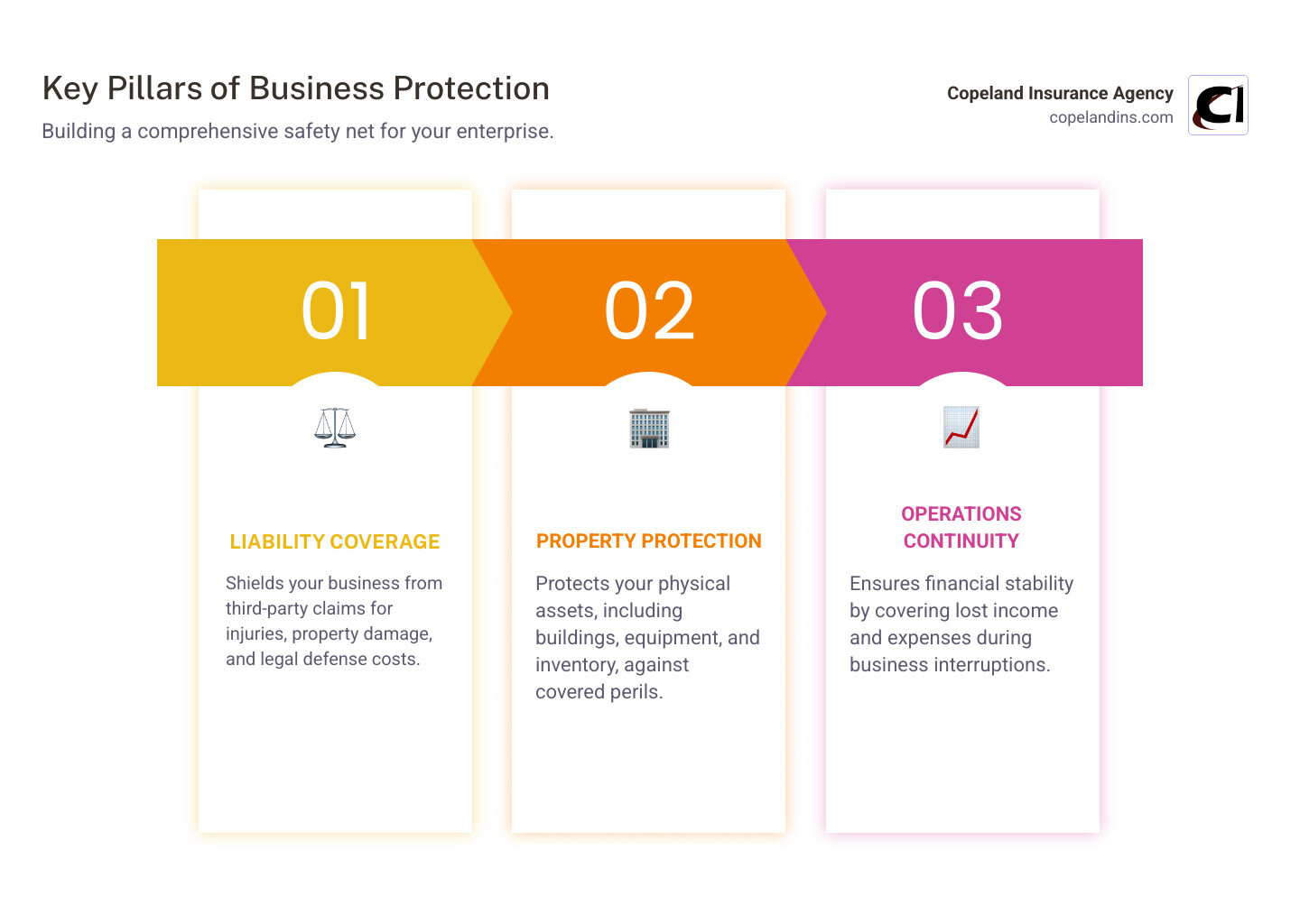
- General Liability Insurance: Protects your business against third-party claims for bodily injury and property damage that occur on your premises or as a result of your operations.
- Commercial Property Insurance: Covers your physical assets, including your building, equipment, and inventory, from perils like fire, theft, and certain natural disasters.
- Business Interruption Insurance: A critical component that replaces lost income and covers ongoing expenses if a covered event forces you to temporarily shut down your operations.
- Workers’ Compensation: Required by law in most states for any business with employees, this covers medical costs and lost wages for work-related injuries or illnesses.
- Professional Liability (E&O): Also known as Errors and Omissions insurance, this covers claims of professional mistakes, negligence, or failure to perform your professional duties.
- Commercial Auto Insurance: Protects vehicles owned or used by your business, covering liability and physical damage from accidents.
- Cyber Liability Insurance: An increasingly vital coverage that protects your business from the financial fallout of data breaches, ransomware, and other cyber attacks.
Accidents, mistakes, and disasters are an unfortunate reality of doing business. A customer could slip and fall in your store, a fire could destroy your entire inventory, an employee could be injured while on the job, or a hacker could steal your customer’s sensitive data. Without the proper coverage in place, any one of these unexpected events could result in thousands or even millions of dollars in costs, potentially forcing you to close your doors for good.
At Copeland Insurance Agency, we have spent over two decades helping Midwest business owners navigate the complexities of business insurance. We do not just sell policies; we specialize in building customized, multi-faceted protection plans because we have seen firsthand how having the right coverage can be the definitive difference between a minor, manageable setback and a business-ending catastrophe. Our goal is to provide you with the security and peace of mind needed to focus on what you do best: running your business.
Explaining “Comprehensive Business Insurance”
Comprehensive business insurance is not a single policy you can buy off the shelf. It is a custom-built portfolio of different insurance coverages that work in concert to protect your business from a wide variety of risks. The best way to think of it is like building layers of protection around your assets and operations, with each individual policy designed to address a different type of potential problem. These problems can range from the tangible and immediate, like a customer slipping and falling in your store, to the complex and digital, like a sophisticated cyber attack on your company’s systems.
The term itself has evolved significantly over the years. Veteran business owners may recall hearing about “comprehensive general liability insurance,” but this is an outdated term that was officially phased out by the insurance industry decades ago. Today, the correct and standard term is simply general liability insurance. The word “comprehensive” was intentionally dropped by insurance standards organizations because it was proving to be misleading. It incorrectly suggested to many business owners that a single policy could cover every conceivable risk, which is never the case in insurance. This important change in terminology helps set clearer, more accurate expectations about what a foundational liability policy actually covers.
General liability insurance is the bedrock of most business protection plans. It specifically covers claims from third parties, such as customers, clients, or vendors, for bodily injury or property damage that your business operations may have caused. For example, if a client trips over a loose cord in your office and breaks their wrist, or if one of your employees accidentally damages a customer’s expensive equipment while on a service call, general liability insurance is what helps cover the associated legal defense costs, medical bills, and potential settlements or judgments. These are the everyday risks that any business interacting with the public faces. You can find more details on our general liability insurance page.
What Is Included in a Comprehensive Business Insurance Package?
A well-designed comprehensive business insurance package always begins with a thorough and detailed risk assessment. At Copeland Insurance Agency, we partner with you to identify your specific vulnerabilities, from the obvious to the overlooked, and then build a collection of coverages to address them methodically. Your package will typically start with a core set of policies like general liability, commercial property, and business interruption insurance. From that foundation, we then strategically add specialized policies based on the unique demands of your industry and the specific nature of your operations.
For example, a restaurant in Kansas needs a very different set of coverages (like spoilage coverage for refrigerated goods, liquor liability if it serves alcohol, and robust protection for kitchen fires) than a consulting firm in Arizona. The consulting firm, on the other hand, may have minimal physical risk but faces significant exposure to claims of professional negligence, data breaches of sensitive client information, and reputational harm. Optional endorsements can further fine-tune your plan, filling very specific gaps like adding coverage for hired and non-owned auto liability or increasing limits for specific types of equipment. The ultimate goal is to create a fully customized protection plan that fits your unique operational footprint and risk profile perfectly. You can explore our options on our insurance solutions page.
Common Exclusions to Be Aware Of
Even the most robust and well-crafted insurance package has its limits. Every individual policy contains exclusions, which are specific situations, perils, or types of damages that are not covered by that policy. Understanding these exclusions is not about finding flaws in the insurance; it is a crucial step that helps us identify where you might have remaining gaps in your protection that require additional, specialized coverage.
- Professional Errors: General liability insurance does not cover financial harm caused to a client because of bad advice or a professional mistake. For that specific risk, you need professional liability (E&O) insurance.
- Employee Injuries: Injuries sustained by your employees while on the job are explicitly excluded from general liability. These situations require workers’ compensation insurance, which is mandated by law for most employers.
- Commercial Auto Accidents: Accidents involving vehicles used for business purposes, whether they are owned by the company or by an employee, require a dedicated commercial auto policy.
- Intentional Acts: Insurance is designed to cover accidents and unforeseen events, not deliberate wrongdoing or illegal acts committed by you or your staff.
- Cyber Attacks: Most traditional business policies were not designed to cover the complex costs of a data breach or cyber attack. Cyber liability insurance is now an essential policy for this growing and significant risk.
- Certain Natural Disasters: Catastrophic events like floods and earthquakes are almost always excluded from standard property policies and require separate, dedicated insurance policies.
These exclusions are not weaknesses in your coverage; they are the boundaries that define what a policy is meant to do. By understanding them, we can strategically build a truly complete protection plan by adding the specialized policies needed to fill those gaps.
The Core of Comprehensive Coverage: The Business Owner’s Policy (BOP)
For many small to medium-sized businesses, the cornerstone of a comprehensive business insurance strategy is the Business Owner’s Policy (BOP). A BOP is an intelligently designed bundle that combines several of the most essential business coverages into one convenient and cost-effective package. It is specifically designed for businesses in lower-risk industries, such as retail stores, small professional offices, and certain artisan contractors, that generally have fewer than 100 employees and under $5 million in annual sales. Businesses with more complex or higher-risk operations, like restaurants, bars, auto repair shops, or manufacturers, typically require more specialized, separate policies rather than a BOP.
A BOP simplifies insurance management by bundling general liability, commercial property, and business interruption policies together, often at a significantly lower premium than if you were to purchase each policy separately. It provides a strong and efficient foundation for a comprehensive plan, which can then be supplemented with other specialized coverages as needed to address any remaining risks unique to your business.
Learn more about how a BOP can benefit your business on our page: More info about Business Owners Insurance. For general information, you can also consult this guide to the Business Owner’s Policy (BOP).
Let’s break down the three key components that form the core of a standard BOP:
1. Commercial Property Insurance
This vital coverage protects your business’s physical assets from damage or loss due to a wide range of events, often referred to as “covered perils.” These typically include fire, storms, theft, or vandalism. It covers not just the building you own in a place like Topeka or Junction City, Kansas, but also all the essential items required for your operations. It is important to note what is not covered, as standard property policies almost always exclude damage from floods, earthquakes, and general wear and tear. These require separate, specialized policies. Key assets covered by commercial property insurance include:
- Buildings: The physical structure itself, including permanently installed fixtures.
- Equipment: Your computers, machinery, specialized tools, and other operational hardware.
- Inventory: Your stock of goods held for sale.
- Business Personal Property: This broad category includes your furniture, fixtures, office supplies, and other items not held for sale.
For a deeper look at protecting your physical assets, visit our page on Commercial Property Insurance.
2. General Liability Insurance
As a core and non-negotiable part of any BOP, general liability insurance serves as your primary defense against claims that your business operations caused harm to others (third parties). This coverage is absolutely vital for any business that interacts with the public in any capacity, whether in person or online.
Coverage typically includes:
- Customer Injuries: If a customer is injured at your location in Salina, Kansas, this covers their medical expenses and your legal costs.
- Client Property Damage: Pays for the repair or replacement if your employee accidentally damages a client’s property during a job.
- Advertising Injury: Protects against claims of libel, slander, copyright infringement, or misappropriation of advertising ideas in your marketing materials.
- Legal Defense Costs: Crucially, this covers attorney fees, court costs, and other legal expenses, even for claims that are ultimately found to be baseless.
3. Business Interruption Insurance
If a fire, major storm, or another covered event forces your business in Manhattan, Kansas, to close its doors temporarily, business interruption insurance can be a true lifesaver. This coverage is designed to replace the income you lose and cover necessary ongoing expenses while you are unable to operate, helping you survive the shutdown and get back on your feet. This coverage is subject to a “period of restoration,” which is the time it reasonably takes to repair the damage and resume operations. It also typically has a waiting period, similar to a deductible, meaning coverage might begin 24 or 72 hours after the initial disruption.
It typically covers:
- Lost Income: Replaces the net profits you would have earned based on historical financial performance.
- Operating Expenses: Helps you continue to pay for essential costs like rent, utilities, and employee payroll.
- Temporary Relocation Costs: Covers the additional expense of moving to and operating from a temporary location while your primary premises are being repaired.
This coverage ensures business continuity and protects your revenue stream during a potentially devastating disruption. Learn more about this essential protection at More info about Business Interruption Insurance.
Building Your Shield: Essential Policies for a Complete Plan
While a Business Owner’s Policy (BOP) provides a fantastic and efficient foundation, a truly comprehensive business insurance strategy requires adding specialized policies to cover risks that are unique to your industry and operations. A construction contractor in Junction City, Kansas, faces a vastly different set of challenges and liabilities than an IT consultant working remotely in Phoenix, Arizona. At Copeland Insurance Agency, we work closely with business owners to perform a deep dive into their specific operations, identifying these unique needs and strategically filling any potential coverage gaps to ensure there are no surprises.

Beyond the core coverages found in a BOP, several key policies are often necessary to complete your protection plan.
Workers’ Compensation Insurance
If you have employees, workers’ compensation insurance is not just a good idea; it is almost certainly required by law. Federal and state laws mandate this coverage to protect your workforce. It covers an employee’s medical expenses, rehabilitation costs, lost wages, and disability benefits if they are injured or become ill as a direct result of their work. In the tragic event of a work-related death, it also provides benefits to the employee’s dependents. This coverage is considered an “exclusive remedy” in most states, which means that by providing this coverage, the employer is protected from most lawsuits by injured employees. This protects your employees while shielding your business from potentially devastating litigation. For sole proprietors without any employees, this coverage typically does not apply, but personal disability insurance is a wise consideration to protect your own income. Ensure your team is protected by learning more at: More info about Workers Compensation Insurance.
Commercial Auto Insurance
If your business owns, leases, or rents vehicles, or if your employees use their personal cars for work-related tasks, you need commercial auto insurance. Personal auto policies almost always exclude coverage for incidents that occur while a vehicle is being used for business purposes, creating a major liability gap. This coverage protects business-owned vehicles and can be extended to cover liability for employee-used vehicles during work activities through what is known as Hired and Non-Owned Auto coverage. This is a critical endorsement for any business where employees might run errands, visit clients, or make deliveries using their own cars. It includes liability protection for accidents causing injury or property damage to others, as well as optional physical damage coverage for your own vehicles. Whether you are a contractor in Marysville, Kansas, with a fleet of trucks or a consultant in Phoenix traveling to client sites, this insurance is crucial. Keep your business moving safely with: More info about Business Auto Insurance.
Professional Liability (E&O) Insurance
Also known as Errors & Omissions (E&O) insurance, this policy is absolutely vital for any business that provides advice, professional services, or designs for a fee. General liability insurance does not cover financial losses that a client suffers due to your work, advice, or failure to perform your services correctly. E&O insurance is specifically designed to protect you against claims of negligence, errors, omissions, or malpractice in the services you provide. For example, if an architect’s design contains a flaw that results in costly structural problems, or a financial advisor’s recommendation leads to a major investment loss for a client, E&O insurance is designed to cover the legal defense and potential settlement. It covers legal defense costs, judgments, and settlements, even for baseless claims, protecting your professional reputation and your personal and business finances. This is essential for consultants, accountants, real estate agents, architects, engineers, and many other professions. Protect your expertise with: More info about Errors and Omissions Liability Insurance.
Cyber Liability Insurance
In today’s digital world, cyber liability insurance is no longer an optional add-on but a core necessity for a truly comprehensive business insurance plan. Any business that uses computers, stores customer data electronically, processes online payments, or even just has a website faces significant cyber risks. This policy is designed to protect against the high costs of data breaches, ransomware attacks, and other cyber incidents. It typically includes both first-party coverages (costs your business directly incurs, like hiring a forensic IT team, paying for data restoration, and public relations) and third-party coverages (your liability to others, such as legal fees and settlements if customers sue you for their data being compromised). A single breach can be financially and reputationally devastating, making this coverage essential for businesses of all sizes. Secure your digital operations with: More info about Cyber Liability Insurance.
Navigating the Cost and Purchase Process
The cost of comprehensive business insurance is not a fixed number; it varies widely depending on your business’s unique risk profile and coverage needs. A construction company with a large payroll and heavy equipment will naturally have a higher insurance cost than a solo freelance consultant working from home. Understanding the specific factors that insurance carriers use to calculate these costs can make the entire process much clearer and help you manage your budget effectively.

As a general starting point, a Business Owner’s Policy (BOP) for a small, low-risk business typically costs around $1,200 per year, while a standalone general liability insurance policy has a national median cost of about $60 per month. However, your actual cost for a complete package could range anywhere from $500 to $3,500 annually, or much more for higher-risk operations. It is crucial to think of this cost not as an expense, but as a vital investment that protects your business from potentially catastrophic financial losses that could otherwise force you to shut down.
Factors That Influence Your Premium
Several key factors combine to determine your final insurance premium. An underwriter will analyze each of these to assess your business’s level of risk:
- Industry Risk: The inherent risk of your industry is one of the largest factors. Higher-risk industries like construction, roofing, or transportation will pay more than lower-risk ones like accounting, consulting, or freelance writing.
- Business Location: Where your business operates matters. A retail shop in a busy urban commercial district in Overland Park, Kansas, faces different risks (like higher rates of theft or foot traffic liability) than a home-based business in rural Riley, Kansas. Local crime rates, weather patterns (like tornado alleys in the Midwest or hurricane zones on the coast), and the quality of local fire protection services all play a role.
- Business Size: More employees, a larger physical space, and higher annual revenue generally indicate greater exposure to risk, which can increase insurance costs.
- Claims History: Your business’s past claims history is a strong predictor of future claims. A clean record with no prior losses can help keep your premiums down, while a history of frequent or severe claims will lead to higher costs.
- Coverage Choices: The specific limits and deductibles you choose will directly impact your premium. Higher coverage limits or lower deductibles will increase your premiums, while lower limits or higher deductibles can reduce them. A deductible is the amount you pay out-of-pocket on a claim before the insurance kicks in. Choosing a higher deductible signals to the insurer that you are willing to absorb smaller losses yourself, which can lead to a lower premium, but it also means more financial responsibility for you when a claim occurs. It is a critical balance between managing your upfront costs and your potential exposure in the future.
How to Purchase Comprehensive Business Insurance
Getting the right coverage for your business does not have to be an overwhelming or confusing process. At Copeland Insurance Agency, we follow a straightforward, consultative process to ensure you get the protection you need:
- Assess Your Risks: We work with you to gain a deep understanding of your specific operations, assets, employees, and potential liabilities, whether you are in Manhattan, Kansas, or another state we serve. Before you even speak to an agent, take a detailed inventory of your business. This includes physical assets (buildings, equipment, inventory), digital assets (customer data, intellectual property), your daily operations, and your employees’ roles. This preparation will make the conversation with your agent far more productive.
- Find the Best Options: As an independent agency, we are not beholden to a single insurance company. We leverage our network of multiple top-rated carriers to shop the market on your behalf, creating competition for your business to find the best combination of coverage and pricing for your specific needs.
- Compare and Explain: We do not just hand you a stack of quotes. We present you with clear, side-by-side options, explaining the differences in coverage, limits, exclusions, and cost in plain, easy-to-understand language.
- Review and Adjust: Your business is not static, and your insurance should not be either. We recommend at least an annual review of your policies to ensure your coverage still fits as your business grows, adds employees, or expands its services.
The Small Business Administration offers additional helpful resources on types of business insurance. Getting comprehensive business insurance is about building a lasting partnership with an agency that understands your business and is committed to your long-term success.
Legal Requirements and Business Structures
Understanding the legal requirements for business insurance is a critical responsibility for any business owner, as mandates can vary significantly by state and federal law. Beyond just legal compliance, having the proper insurance in place provides essential financial stability and robust asset protection, regardless of how your business is legally structured.

Some types of business insurance are not just smart investments in risk management, they are legally required for you to operate. Whether your business is located in Manhattan, Kansas, or Phoenix, Arizona, knowing these obligations is an essential part of compliance and protecting your livelihood.
State and Federal Insurance Mandates
The federal government requires that every business with employees must have workers’ compensation, unemployment, and disability insurance. State-specific requirements can add another layer of complexity, as thresholds for when coverage is required vary significantly. For example, some states require workers’ comp insurance if you have just one employee, while others set the threshold at three or five. Depending on your state, industry, or even your commercial lease agreement, public liability insurance (another term for general liability) may also be mandated. Landlords, for instance, almost universally require their commercial tenants to carry a specific minimum amount of liability insurance and to name the landlord as an additional insured on the policy. Furthermore, if your business owns or uses vehicles for any work-related purpose, commercial auto insurance is a legal requirement, just like personal auto insurance is for individuals.
At Copeland Insurance Agency, we stay current on these evolving requirements across all nine states we serve, including Kansas, Arizona, and Texas, to ensure your business remains fully compliant and avoids potential fines or penalties.
How Insurance Needs Vary by Business Structure
Your legal business structure has a direct and significant impact on your level of personal liability and, consequently, your insurance needs. The right insurance plan complements your legal structure to create a complete asset protection strategy.
| Business Structure | Personal Asset Risk | Business Asset Protection | Key Insurance Consideration |
|---|---|---|---|
| Sole Proprietorship | High – Personal assets are legally indistinguishable from business assets and are fully at risk. | Limited – There is no legal separation between personal and business assets. | Comprehensive business insurance is absolutely crucial. Without it, a business lawsuit could seize your personal bank accounts, car, and even your home. Insurance is the primary shield for your personal wealth. |
| Limited Liability Company (LLC) | Lower – Personal assets are generally protected from business debts and lawsuits by the “corporate veil.” | Moderate – The business’s assets are still vulnerable to lawsuits and other losses. | Business insurance protects the company’s capital, equipment, and ability to operate, preserving the value of the owner’s investment. It also reinforces the legal separation that the LLC structure is designed to provide. |
| Corporation | Lowest – Provides the strongest legal separation and protection for personal assets. | High – There is a clear legal separation between corporate assets and personal assets. | Business insurance is still vital to protect corporate assets, ensure operational continuity, fulfill fiduciary duties to the board of directors, and safeguard shareholder interests from being wiped out by a major loss. |
- Sole Proprietorships carry the highest personal risk because, in the eyes of the law, there is no distinction between the owner and the business. Business insurance is your primary, and often only, defense for protecting personal assets like your home and savings from a business lawsuit.
- Limited Liability Companies (LLCs) offer a valuable “corporate veil” that generally protects your personal assets from business liabilities. However, the business’s assets remain vulnerable, and the corporate veil can be “pierced” by a court if business and personal finances are co-mingled or the business is not run properly. Business insurance is necessary to protect the company itself.
- Corporations provide the strongest personal asset protection. However, insurance is still vital to protect the corporation’s assets, ensure it can continue to operate after a major loss, and safeguard the interests of its shareholders.
Regardless of your chosen legal structure, comprehensive business insurance acts as an essential financial safety net that complements and reinforces your legal protections, providing a second wall of defense against financial disaster.
Conclusion: Your Partner in Protection
Building the right comprehensive business insurance plan is about creating a custom shield that fits your business perfectly. It is not about simply buying a collection of off-the-shelf policies; it is about strategically and thoughtfully protecting the enterprise you have worked so hard to build. From a foundational Business Owner’s Policy that covers your core exposures to highly specialized coverages like cyber and professional liability, each piece serves a distinct and vital purpose in your overall risk management strategy. A well-crafted plan is a strategic investment in the resilience and longevity of your business.
Ultimately, comprehensive business insurance provides the invaluable asset of peace of mind. It is the mechanism that ensures an unexpected event, whether it is a lawsuit, a fire, a natural disaster, or a data breach, is a manageable setback rather than a permanent closure. It allows you to operate with confidence, knowing that you have a financial backstop in place for a wide range of potential catastrophes.
At Copeland Insurance Agency, our mission is to be your long-term partner in protection. This partnership goes far beyond the initial transaction. It involves conducting annual policy reviews to ensure your coverage evolves with your business, offering proactive advice on managing new risks as you grow or expand, and serving as your dedicated advocate during the claims process to ensure you receive a fair and prompt resolution. We serve businesses across nine states, from a cafe in Manhattan, Kansas, to a tech startup in Austin, Texas, and we understand that each one has unique insurance needs. Our approach is simple: we listen to understand your risks and goals, then craft a plan that makes sense for you today and supports your growth tomorrow.
Ready to build your business’s safety net? The journey begins with a clear and honest understanding of your risks. We are here to help you take that first step toward achieving true confidence and security in your business venture.
Learn more about our commitment to dedicated service at About Our Agency.
When you are ready, Get a quote for General Liability Insurance today and find out how the right coverage can protect your future.