

Single Truck Insurance: Ultimate 2025 Guide
Why Single Truck Insurance Is Essential for Owner-Operators
Single truck insurance is a specialized suite of commercial auto policies meticulously crafted for the unique world of the owner-operator and the small trucking business with one power unit. When you own and operate a single truck, you are more than just a driver; you are the CEO, the chief financial officer, the dispatcher, and the head of maintenance. Every decision, from which loads to take to which insurance policy to buy, directly impacts your bottom line and the long-term viability of your business. In this high-stakes environment, understanding your insurance is not just a regulatory hurdle; it is a fundamental pillar of your business strategy, critical for protecting your assets and ensuring legal compliance.
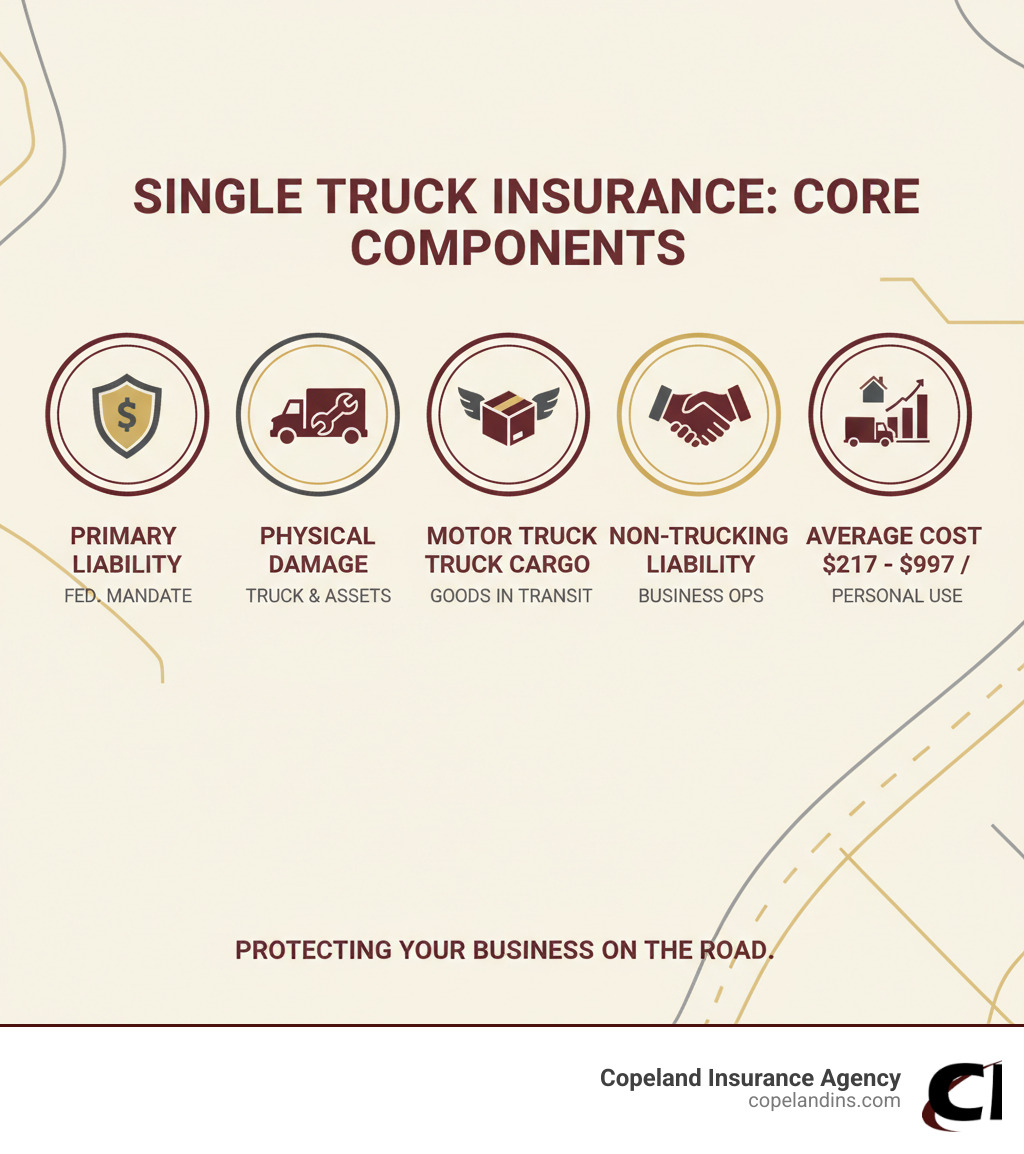
Here’s a quick overview of what a robust policy entails:
- Core Coverages: A standard policy is built on a foundation of Primary Liability (a non-negotiable federal requirement), Physical Damage (which protects your most valuable asset, your truck), and Motor Truck Cargo (which covers the freight you are paid to haul). These three components form the basic shield against the most common and significant risks you face on the road.
- Average Cost: The investment in this protection can vary significantly. Most owner-operators can expect to pay between $217 to $997 per month for a standard $1 million liability policy. This wide range reflects the highly personalized nature of insurance, with premiums depending on your driving record, the type of cargo you haul, your routes, and more.
Federal regulations, enforced by the Federal Motor Carrier Safety Administration (FMCSA), mandate minimum coverage levels to ensure you can cover damages in the event of an accident. However, the reality of the industry is that most brokers and shippers will require coverage limits far exceeding these minimums. The right policy does more than just check a box; it protects your investment, shields your personal assets from the devastating financial fallout of an accident, a cargo claim, or a lawsuit, and gives you access to better-paying loads. It is the bedrock of a resilient and successful trucking business.
At Copeland Insurance Agency, we specialize in helping owner-operators navigate the complexities of single truck insurance. We recognize that your truck is your livelihood, and our mission is to build custom policies that provide comprehensive protection without breaking the bank, allowing you to drive with confidence.
Essential Coverages for Your Single Truck Operation
Building a solid single truck insurance policy is like constructing a fortress around your business. It is a strategic process of creating a comprehensive safety net that goes far beyond simply meeting minimum legal requirements. It is about proactively protecting yourself, your assets, and your future from the countless unexpected events that can occur on the road. Let’s break down the essential coverages that form the walls of this fortress.

Mandatory Liability Coverages
Liability coverage is your primary financial shield. If you are found at fault in an accident, this coverage steps in to pay for the damages and injuries you caused, preventing a catastrophic event from bankrupting your business. Without it, you cannot legally operate a commercial truck.
- Bodily Injury & Property Damage Liability: This is the cornerstone of your policy. Bodily Injury coverage pays for the medical expenses, lost wages, and pain and suffering of people injured in an accident you cause. Property Damage covers the cost to repair or replace other people’s property, such as vehicles, buildings, or guardrails. Given the size and weight of a semi-truck, the potential for damage is immense, making high liability limits essential.
- FMCSA Requirements: The Federal Motor Carrier Safety Administration has strict insurance filing requirements. Most interstate truckers hauling non-hazardous goods need a minimum of $750,000 in primary liability. This is proven to the FMCSA via a BMC-91 or BMC-91X filing from your insurer. Failure to maintain this filing results in the immediate suspension of your operating authority, effectively shutting down your business.
- Uninsured/Underinsured Motorist (UM/UIM): This vital coverage protects you. If you are involved in an accident where the other driver is at fault but has no insurance (uninsured) or not enough insurance (underinsured) to cover your medical bills and truck repairs, your UM/UIM coverage steps in. It ensures you are not left with a mountain of bills due to someone else’s irresponsibility.
For a deeper dive into these critical protections, see our guide on Truck Liability Coverage.
Protecting Your Asset: Physical Damage & Cargo
Your truck and the freight you haul are your primary business assets and revenue generators. They require dedicated protection.
- Physical Damage: This coverage is designed to repair or replace your truck if it is damaged. It is typically composed of two parts: Collision coverage, which pays for damage resulting from a collision with another vehicle or object, and Comprehensive coverage, which handles non-collision events like fire, theft, vandalism, hail, flooding, or hitting an animal. Policies usually pay the Actual Cash Value (ACV) of your truck, which is its market value minus depreciation. It is crucial to ensure this value is accurately stated to avoid being underinsured.
- Motor Truck Cargo Insurance: This protects the freight you are hauling from damage, loss, or theft. While the FMCSA may only require a nominal $5,000, this is practically irrelevant. Most brokers and shippers will not work with you unless you carry a minimum of $100,000 in cargo coverage, and those hauling high-value loads may need $250,000 or more. Be aware of common exclusions, such as unattended vehicle theft or spoilage due to equipment breakdown (which may require separate Reefer Breakdown coverage). Learn more in our guide to Motor Truck Cargo Insurance.
Always meticulously review your policy exclusions (what is not covered) and deductibles (your out-of-pocket share of a claim). A higher deductible can lower your premium, but you must be financially prepared to pay it at a moment’s notice.
Specialized & Optional Coverages
These coverages fill specific, common gaps in standard policies, providing a more complete layer of protection.
- Bobtail/Non-Trucking Liability: This is crucial for owner-operators, especially those leased to a carrier. It provides liability protection when you are driving your truck for non-business purposes (Non-Trucking) or without a trailer when not under dispatch (Bobtail). Our guide explains What is Non-Trucking Liability Insurance? Everything You Need to Know.
- Trailer Interchange: If you haul trailers you do not own under a trailer interchange agreement (common in intermodal shipping), this coverage protects that trailer from physical damage. It is often a requirement to gain access to ports and rails.
- Passenger Accident: Standard policies do not cover non-employee passengers. This coverage provides medical and accidental death and dismemberment benefits if an authorized passenger (like a spouse) is injured in your truck.
- Downtime & Rental Reimbursement: If your truck is out of commission due to a covered physical damage claim, every day is lost revenue. Downtime coverage provides a pre-determined daily payment to help cover your lost income, while Rental Reimbursement helps pay for a replacement truck, keeping your business moving forward.
Who Needs This Coverage and How Does It Differ?
Single truck insurance is not a monolithic product. The right policy for you is determined by your specific business structure and operational model. The most significant distinction is whether you operate under your own authority as a fully independent business or lease your services and truck to a larger motor carrier. Understanding this difference is the first step to preventing dangerous and potentially bankrupting coverage gaps.

Owner-Operators vs. Leased Drivers
The fundamental difference boils down to one question: who is responsible for providing the primary liability and cargo insurance?
-
Independent Contractor with Own Authority: If you have your own Motor Carrier (MC) number, you are the motor carrier. You are the captain of your own ship, which means you are solely responsible for securing and maintaining all necessary insurance. This includes the primary liability, motor truck cargo, and any other coverages required by law and your customers. Your insurance needs are comprehensive, as there is no larger company’s policy to fall back on. You must purchase a full commercial trucking policy that covers you for all business operations.
-
Owner-Operator Leased to a Motor Carrier: In this arrangement, you lease your truck and your services to a larger carrier. The carrier’s insurance policy typically provides your primary liability and cargo coverage, but with a critical limitation: it only applies while you are under their dispatch, actively hauling a load for them. This creates significant gaps. The moment you drop off a load and are no longer under dispatch, you are uninsured for liability. The carrier’s policy does not cover you while driving home, to a repair shop, or using your truck for personal errands (deadheading). Furthermore, the carrier’s policy almost never covers physical damage to your truck. As a leased operator, you are responsible for purchasing your own Physical Damage policy to protect your truck and a Non-Trucking Liability policy to cover you during those uninsured periods.
Our Owner Operator Insurance guide details these scenarios with clear examples to help you pinpoint your exact needs and avoid common pitfalls.
Single Truck vs. Fleet Insurance
The underwriting process and policy structure for a single truck are fundamentally different from those for a fleet.
-
Single Truck Insurance: The policy is hyper-focused on you and your single vehicle. Underwriters scrutinize your individual driving record (MVR), your years of commercial driving experience, your personal credit history in some cases, and your individual CSA score. There is no fleet average to blend into, which means your personal history and safety record have a direct and significant impact on your rates. A clean record is paramount for securing affordable premiums. The advantage is that your policy can be perfectly customized to your specific operation, cargo, and routes.
-
Fleet Insurance: This type of policy is designed to cover multiple vehicles (typically five or more) under a single, unified plan. It offers administrative simplicity and often provides volume discounts, potentially lowering the per-vehicle cost. Premiums are calculated based on the fleet’s collective performance, including its overall safety record, average driver experience, loss history, and the strength of its risk management programs. The risk is pooled, so one driver’s minor incident may have less impact than it would on a single-truck policy.
Starting with a strong, well-structured single truck policy is the best way to build a solid foundation for growth. When you are ready to add a second truck and begin scaling your business, our Fleet Insurance guide explains how to make a smooth and cost-effective transition.
Decoding the Cost of Your Single Truck Insurance Policy
If you are an owner-operator shopping for single truck insurance, the price quotes you receive can seem all over the map. It is common for a standard policy with a $1 million liability limit to range from $217 to $997 per month, and sometimes even higher. This vast difference is not arbitrary; your insurance premium is a direct reflection of the level of risk an insurer perceives in your specific operation. It is a complex calculation based on a multitude of factors.
Understanding these factors is empowering. It allows you to identify areas where you can improve your risk profile, giving you more control over your insurance costs and helping you secure the best possible rate. For a comprehensive breakdown, refer to our detailed guide on How Much Does Commercial Truck Insurance Cost?.
Key Factors Influencing Your Single Truck Insurance Cost
Insurance underwriters are risk analysts. They evaluate every detail of your operation to predict the likelihood of a future claim. Here are the most influential factors:
- Driving Record and Experience: This is paramount. A clean Commercial Driver’s License (CDL) and a long, verifiable history of accident-free commercial driving will always result in lower rates. Conversely, a history of accidents, speeding tickets, or other moving violations will significantly increase your premium.
- Truck Type, Age, and Value: The value of your truck is a primary driver of your physical damage premium. A brand-new, $180,000 tractor will cost more to insure than a 10-year-old model valued at $40,000. Newer trucks with advanced safety features like collision mitigation systems or lane departure warnings may earn you discounts.
- Cargo Hauled: What you transport is a major indicator of risk. Hauling general, non-perishable freight is the baseline. Transporting more valuable goods like electronics, or riskier materials like automobiles, steel coils, or hazardous chemicals, will increase your cargo and liability premiums due to the higher potential for loss.
- Operating Radius: Where you drive matters. Local routes (typically within a 100-mile radius) are generally seen as lower risk and have lower premiums. Regional (up to 500 miles) and long-haul, cross-country routes involve more time on the road and exposure to diverse traffic and weather conditions, leading to higher rates.
- Coverage Limits and Deductibles: The amount of coverage you buy directly impacts the price. Opting for a $2 million liability limit instead of $1 million will cost more. Similarly, your deductible choice affects your physical damage premium. A higher deductible (e.g., $2,500) means you take on more risk, so the insurer charges you a lower premium. A lower deductible (e.g., $1,000) means the insurer takes on more risk, so your premium is higher.
- Safety Record and CSA score: Your Compliance, Safety, Accountability (CSA) score, maintained by the FMCSA, is a public-facing report card of your safety performance. A low score with no alerts in the BASICs (Behavior Analysis and Safety Improvement Categories) demonstrates you are a low-risk operator and can lead to significant premium reductions.
- Location: Your garaging address, the primary location where you park your truck, influences your rate. Operating in dense, high-traffic urban areas like Los Angeles or Chicago typically costs more than operating in rural regions due to higher theft and accident rates.
How to Find the Best Quotes and Save Money
Finding affordable coverage should never mean sacrificing essential protection. Here are proven strategies to lower your premiums:
- Work with an Independent Agent: An independent agent, like Copeland Insurance Agency, is not tied to a single company. We represent multiple carriers and shop the market on your behalf, comparing coverage options and pricing to find the optimal solution for your business.
- Maintain a Strong Safety Program: Proactive safety management pays dividends. Documented vehicle maintenance schedules, the use of telematics or dashcams, and a commitment to clean inspections show insurers you are a responsible risk, often leading to discounts.
- Pay Your Premium in Full: If your cash flow allows, paying your annual premium upfront can often earn you a discount of 5-15%. Insurers prefer this as it reduces their administrative costs and billing risk.
- Choose Higher Deductibles: If you have a healthy emergency fund, opting for a higher deductible on your physical damage and cargo policies is a direct way to lower your monthly premium. Just be certain you can comfortably cover that out-of-pocket cost if you need to file a claim.
For more actionable tips, explore our guide on finding Cheap Truck Insurance Rates.
Securing Your Policy and Protecting Your Business
Proper single truck insurance is the architectural blueprint for a secure and lasting business. It acts as a powerful safeguard for your livelihood, your professional reputation, and your personal financial well-being. Viewing insurance not as a mere expense but as a strategic investment in resilience is the mindset of a successful owner-operator. It is about building an operation that can withstand the inevitable bumps in the road and continue to thrive.

The Process for Obtaining Single Truck Insurance
While the world of insurance can seem daunting, the process of getting your policy in place can be straightforward and efficient, especially with the right preparation and guidance.
- Gather Documents: Before you start, collect all necessary information. This includes your driver’s license (CDL), the Vehicle Identification Number (VIN) for your truck, your USDOT and MC numbers (if you have your own authority), your business address, and details about your driving history and planned operations (cargo, routes).
- Complete the Application: Work with your agent to fill out the application. Be thorough and, above all, be honest. Providing accurate information about your driving history, business operations, and prior claims is crucial. Misrepresentation can lead to claim denial or even policy cancellation for fraud.
- Underwriting Review: The insurance carrier’s underwriting department will review your application. They will pull your Motor Vehicle Report (MVR), check your CSA score, and analyze all the data you provided to assess your risk profile and calculate your final premium.
- Bind Coverage: Once the underwriter approves your application and you agree to the quoted premium, your agent will bind coverage. This is the act of making the policy effective. You will typically make your down payment at this stage, and your agent will provide you with a binder, which is temporary proof of insurance.
- Receive Documents: Shortly after binding, you will receive your official policy documents and your permanent proof of insurance cards. Crucially, you will also be able to request Certificates of Insurance (COIs), the documents that brokers and shippers require as proof of your coverage before they will give you a load.
For those just starting their trucking journey, our guide on Trucking Insurance for Startups offers a more detailed roadmap.
The Long-Term Benefits for Your Small Trucking Business
The true value of a quality insurance policy is not just in the piece of paper, but in the long-term stability and opportunity it provides.
- Asset Protection: A modern semi-truck can cost upwards of $180,000. Physical damage coverage ensures that if your primary asset is damaged or destroyed in an accident, you can repair or replace it without facing a devastating, business-ending financial loss.
- Liability Shield: In today’s litigious climate, multi-million dollar lawsuit awards, known as ‘nuclear verdicts’, are a terrifying reality in the trucking industry. Comprehensive liability coverage protects your business and personal assets from being seized to satisfy a judgment.
- Business Continuity: A major accident can put your truck in the shop for weeks or months. Coverages like downtime protection and rental reimbursement are designed to bridge this gap, helping you cover lost income and continue serving customers, which can be the difference between a temporary setback and a permanent closure.
- Access to Better Contracts: The best shippers and brokers have stringent insurance requirements. Carrying high liability limits and robust cargo coverage is not just for protection; it is a key that unlocks the door to more lucrative and consistent freight opportunities.
- Legal Compliance: Proper insurance keeps you in good standing with the FMCSA and state authorities, helping you avoid costly fines, penalties, and the suspension of your operating authority.
Your insurance policy is a fundamental business tool that empowers you to focus on driving and growing your business, confident that you have a powerful safety net in place. Learn more about how to Protect Your Business Assets.
Frequently Asked Questions about Single Truck Insurance
Navigating the world of commercial trucking insurance can bring up a lot of questions. Here are straightforward, detailed answers to some of the most common queries we hear from owner-operators about single truck insurance.
How much does single truck insurance typically cost?
While there is no single answer, the typical range for a standard $1 million primary liability policy is between $217 to $997 per month. It is crucial to understand why this range is so broad. Your final cost is a personalized figure based on your unique risk profile. For example, a 45-year-old driver with 20 years of experience, a clean driving record, and who hauls general freight within a 150-mile radius might be on the lower end of that scale. In contrast, a 25-year-old driver with a new CDL, one minor accident, and plans to haul cars cross-country will face a much higher premium. Factors like your truck’s value, your CSA score, and your garaging location all play a significant role. Your final trucking insurance rates are a direct reflection of the risk an insurer takes on to cover you.
Can I get insurance for just one day?
Yes, temporary or trip-transit truck insurance is available, sometimes for as little as 24 hours. This type of policy is designed for very specific, non-commercial situations. A common use case is when you purchase a truck at an auction or from a private seller and need insurance to legally drive it home. However, it is absolutely critical to understand the limitations: you cannot use temporary insurance for hauling freight. Attempting to operate commercially on a temporary policy can lead to denied claims, fines, and the loss of your operating authority. For any business operations, you must have a full, continuous commercial policy.
Does my policy cover personal use of my truck?
This is one of the most critical and often misunderstood points for owner-operators. In almost all cases, a standard commercial trucking policy does not cover personal use. Your primary liability coverage is for when you are operating for a business purpose, typically under dispatch. If you have an accident while running to the grocery store, visiting family, or on your way to a movie, your commercial policy will likely deny the claim, leaving you personally responsible for all damages.
To close this dangerous gap, you need Non-Trucking Liability (NTL) insurance. This specialized coverage is designed specifically for owner-operators (especially those leased to a carrier) to provide liability protection when using the truck for personal, non-business reasons. It ensures you are protected 24/7, whether you are on or off the clock. Always clarify with your agent exactly when your commercial policy applies and confirm you have the right coverage for personal use.
What is a Certificate of Insurance (COI) and why is it so important?
A Certificate of Insurance, or COI, is a one-page document that summarizes your insurance policy. It lists your named insured, your policy numbers, your coverage types (e.g., Auto Liability, Motor Truck Cargo), and your coverage limits. This document is your passport to getting work. Before a broker or shipper will tender you a load, they will require a COI from you to prove that you meet their insurance requirements. Your insurance agent will issue these certificates on your behalf and send them to the requesting parties. Having an agent who can issue COIs quickly and accurately is essential for keeping your truck moving and generating revenue.
Your Partner in Protection
For an owner-operator, the road to success is paved with hard work, dedication, and smart business decisions. Of all the decisions you will make, choosing the right insurance is arguably the most critical. A comprehensive single truck insurance policy is your most important safety net and a strategic asset. It protects your truck, keeps you legally compliant, and shields your business and personal finances from the risk of financial devastation. This protection allows you to stop worrying about the ‘what ifs’ and focus on what you do best: driving and growing your business.
Understanding your unique coverage needs, from primary liability and cargo to non-trucking liability and physical damage, is the essential first step. The next, equally important step is to partner with an independent insurance expert who can navigate the complex market for you and act as your trusted advisor.
At Copeland Insurance Agency, we have specialized in helping owner-operators build their businesses securely for over two decades. We are not just selling policies; we are building long-term partnerships. We know your truck is your livelihood, and we treat it with the respect it deserves. As independent agents licensed in nine states, including Arizona and Texas, we have the freedom to shop dozens of A-rated insurance carriers to find you the best possible coverage at a highly competitive rate. Our commitment is to provide dedicated, responsive customer service and to craft a policy that is perfectly tailored to your unique operation.
Whether you are based in Manhattan, Topeka, or anywhere in our Kansas service areas and beyond, we are here to guide you. Do not try to navigate the risks of the road alone. Get the robust protection and genuine peace of mind you deserve. Explore your Commercial Truck Insurance options with Copeland Insurance Agency today and let us be your partner in protection.