

Physical Damage Insurance for Commercial Truck and Trailer
Why Physical Damage Insurance is Critical for Your Trucking Business
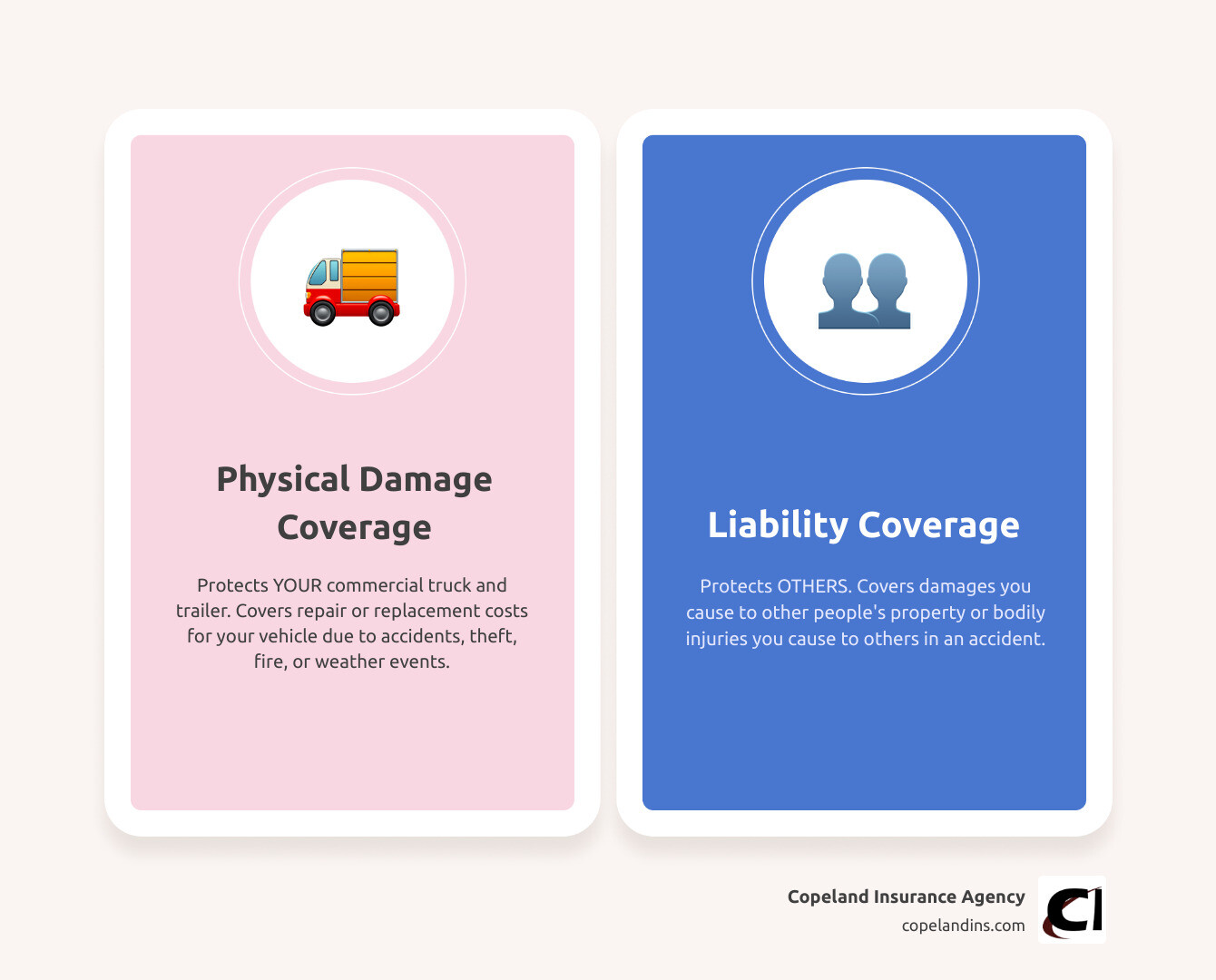
In commercial trucking, your truck and trailer are not just vehicles; they are the engines of your enterprise, your primary income-generating assets, and a massive capital investment. Physical damage insurance for commercial truck and trailer is the essential safeguard that protects these core assets from the financial devastation of accidents, theft, severe weather, or vandalism. While liability insurance is legally required to cover damages you cause to others, physical damage is the first-party coverage that pays to repair or replace your own equipment. Operating without it is equivalent to self-insuring against potential losses that can easily climb into the six-figure range, a risk that could single-handedly bankrupt your business.
Imagine facing a $40,000 bill for cab and engine repairs after a collision or a total loss of your $150,000 rig due to a fire. Without physical damage coverage, these costs come directly out of your pocket, halting your operations and jeopardizing your livelihood. This insurance transforms a potential catastrophe into a manageable, planned-for business expense.
Key Coverage Components:
- Collision Coverage: This is your protection against the costs of repairing or replacing your truck and trailer after an impact-related event. It applies whether you collide with another vehicle, a stationary object like a guardrail or building, or if your vehicle overturns.
- Comprehensive Coverage: This component protects against a wide array of non-collision events. It is your shield against losses from fire, theft of the vehicle, vandalism, natural disasters like hailstorms and floods, and collisions with animals.
- Not Legally Required (But Often Contractually Mandatory): While federal regulations do not mandate physical damage insurance, any financial institution that has provided a loan or lease for your equipment will almost certainly require it to protect their financial interest.
Consider the sobering reality behind the statistics: the Federal Motor Carrier Safety Administration (FMCSA) reported nearly 415,000 large truck collisions in a single recent year. This number isn’t just an abstract figure; it represents thousands of drivers and business owners facing unexpected, often severe, financial and operational crises. For the vast majority of truckers, their vehicle is their entire business. A single major accident without the right insurance coverage is not just a setback-it is often the end of their business dreams.
At Copeland Insurance Agency, we understand that your truck is far more than just a vehicle-it’s your business, your office, and your path to success. For over two decades, we have specialized in helping truckers steer the complexities of physical damage insurance for commercial truck and trailer. Protecting your investment requires a deep understanding of the risks you face on the road. Our dedicated team is here to ensure you have the right coverage at the right price, providing the foundation of security your business needs to thrive.
What is Physical Damage Insurance for Commercial Truck and Trailer?
When your commercial truck is damaged in an accident, stolen from a truck stop, or battered by a hailstorm, who is responsible for the immense cost of repairs or replacement? This is the critical question that physical damage insurance for commercial truck and trailer is designed to answer. At its core, physical damage insurance is a form of “first-party” coverage, meaning it is focused entirely on protecting your financial investment in your own truck and trailer. It is specifically designed to cover the costs to repair or replace your vehicles when they are damaged in an at-fault accident or from a wide range of non-collision events like fire, theft, or hail. It is the policy that safeguards your most valuable assets and ensures your business can keep moving forward after a loss.
For more details on specific coverages, you can explore our guides on Does My Truck Insurance Cover My Trailer? and Semi Truck Insurance.
Core Coverages: A Deep Dive into Collision and Comprehensive
Physical damage insurance for commercial truck and trailer is primarily built on two foundational pillars: Collision and Comprehensive coverage. While often bundled together, they protect against distinctly different types of perils.
Collision Coverage
This coverage specifically pays for damage to your insured truck and trailer resulting from a collision. This includes scenarios such as:
- A collision with another vehicle, regardless of who is at fault.
- A single-vehicle accident, such as hitting a guardrail, a telephone pole, or a building.
- An overturn or rollover incident, for example, if your truck jackknifes on an icy road.
Collision coverage is what gets your equipment back into the repair shop and eventually back on the road after a crash. It is arguably the most frequently used part of a physical damage policy, addressing the most common risks drivers face daily.
Comprehensive Coverage (Also known as “Other Than Collision”)
Comprehensive coverage is your protection against a broad spectrum of non-collision related incidents. It is designed to cover damage from events that are often unpredictable and outside of your control. This includes, but is not limited to:
- Fire or Explosion: Whether from an electrical malfunction, an engine fire, or an external source.
- Theft or Vandalism: This covers the theft of the entire vehicle or damage from attempted theft. It also covers acts of vandalism, such as slashed tires, broken windows, or graffiti.
- Weather Damage: Protection from natural events like windstorms, hailstorms that can cause significant body damage, floods, and even falling objects like tree branches during a storm.
- Animal Strikes: Covers damage from hitting an animal, such as a deer, which can cause extensive damage to the front of a truck.

This powerful combination of Collision and Comprehensive ensures that whether your truck is damaged in a highway accident or by a hailstorm while parked overnight, you have the financial resources to manage the recovery.
What Physical Damage Insurance Does NOT Cover
Understanding the boundaries of your policy is just as important as knowing what it covers. This clarity helps you avoid dangerous gaps in your overall risk management strategy. Physical damage insurance is highly specific and typically excludes:
- Third-Party Liability: It provides zero coverage for damage you cause to someone else’s vehicle, property, or their medical bills. For this, you must have a separate Commercial Auto Liability insurance policy, which is federally mandated.
- Cargo: The freight you are hauling is never covered by a physical damage policy. Protecting your customer’s goods from loss or damage requires a separate Motor Truck Cargo insurance policy.
- Driver’s Personal Items: Personal belongings inside the cab, such as laptops, cell phones, tools, or clothes, are not covered unless you add a specific endorsement for Personal Effects Coverage.
- Normal Wear and Tear: Insurance is for sudden and accidental losses, not routine aging. The policy will not pay for replacing parts that fail due to age or use, such as tires, brakes, or belts.
- Mechanical Breakdown: If your engine or transmission fails due to internal mechanical issues unrelated to an accident, this is not covered. These events fall under maintenance or potential warranty issues, not insurance.
- Legal Fees: Any legal expenses or court judgments resulting from an accident you caused are covered by your liability insurance, not your physical damage policy.
Recognizing these exclusions is the first step in building a complete insurance portfolio that fully protects every facet of your trucking operation.
Do You Need Physical Damage Insurance?
For any commercial truck operator, from a single owner-operator to a large fleet manager, the question is not if you need physical damage insurance for commercial truck and trailer, but rather how you could possibly operate without it. This coverage is not just a good idea-it is an essential component of sound financial planning and risk management, protecting your business from a potentially catastrophic financial blow. Your truck is a massive investment, with new rigs often exceeding $175,000 and even used trucks representing a significant capital outlay. For many, this asset is their entire livelihood. Operating without coverage means you are gambling with your business’s future every single time the wheels turn.
A single serious accident can result in tens of thousands of dollars in repair bills. A new engine can cost over $30,000, cab reconstruction can easily top $20,000, and trailer repairs can be equally expensive. A total loss means you are out the entire value of your vehicle. Physical damage insurance acts as your financial safety net, ensuring that one bad day on the road does not become a business-ending event. For more information on protecting your business vehicles, see our Business Auto Insurance page.
Legal vs. Lender Requirements: A Critical Distinction
A key point that often surprises new truckers is that physical damage insurance for commercial truck and trailer is not legally mandated by the federal government. The FMCSA’s primary concern is public safety, which is why they mandate Public Liability insurance to cover damages you might cause to others. The decision to protect your own equipment, however, is left to you-with one major exception: your lender.

If you have a loan or lease on your truck or trailer, your financing agreement will unequivocally require you to maintain physical damage coverage for the life of the loan. The reason is simple: the lender holds a financial interest (a lien) in your vehicle, and they need to protect their investment against loss. Your loan agreement will specify the coverage requirements, including the maximum allowable deductible. Failing to maintain this coverage is a breach of your loan contract and can lead to serious consequences, such as the lender purchasing expensive “force-placed” insurance and adding the cost to your loan balance, or even repossessing the vehicle.
Who Should Carry Physical Damage Coverage?
Even if your truck and trailer are fully paid off, we strongly recommend physical damage insurance for commercial truck and trailer for nearly every operator in the industry. The risk of a total loss does not disappear just because the lien is satisfied.
- Owner-Operators: For an owner-operator, the truck is the business. A major loss without coverage means not only losing your primary asset but also your source of income, potentially leading to personal financial ruin.
- For-Hire Motor Carriers: Whether you own a small fleet or a large one, your vehicles are your revenue-generating units. Losing even one truck to damage can disrupt schedules, violate contracts with shippers, and significantly impact cash flow. Consistent coverage across the fleet is vital for operational stability.
- Private Carriers: For businesses that use trucks to transport their own goods (e.g., construction, manufacturing, agriculture), the truck is a critical tool. A damaged vehicle can halt a project, delay deliveries to your own customers, and disrupt your core business operations.
- Fleet Owners: The risk is multiplied across every unit in your fleet. Physical damage insurance provides the financial stability needed to repair or replace vehicles quickly, maintaining operational capacity and protecting the overall value of your business.
The bottom line is straightforward: unless you have enough liquid cash readily available to absorb a $100,000+ loss and replace a totaled vehicle without missing a beat, this coverage is an indispensable form of business continuity protection.
Understanding the Cost and Value of Your Policy
The cost of physical damage insurance for commercial truck and trailer is often more affordable than many truckers expect, especially when weighed against the immense value it protects. While rates vary widely, a common industry benchmark for pricing this coverage is approximately $2 to $3 per month for every thousand dollars of your truck’s insured value. For example, a rig valued at $60,000 might have a physical damage premium ranging from $120 to $180 per month. A newer, $150,000 truck could see premiums between $300 and $450 per month. Your final cost is a dynamic figure influenced by your premiums, deductibles, and coverage limits. Understanding how these elements interact is the key to structuring a policy that is both effective and economical. For a full breakdown, see our guide on How Much Does Commercial Truck Insurance Cost?.
Calculating the Value of Your Commercial Truck and Trailer for Physical Damage Insurance
Correctly valuing your truck and trailer is one of the most critical steps in setting up your policy. Insuring your equipment for too little (undervaluing) can leave you with a significant financial shortfall after a total loss, forcing you to cover the difference out-of-pocket to get a comparable replacement. Conversely, insuring it for too much (overvaluing) means you are wasting money on unnecessarily high premiums, as the policy will only pay out the vehicle’s actual worth at the time of the loss, regardless of the higher insured amount. Insurers typically use two primary valuation methods:
- Stated Amount: With this method, you and the insurer agree on a specific value for the vehicle when the policy is written. However, in the event of a total loss, the insurance company will pay the lesser of the stated amount or the vehicle’s Actual Cash Value (ACV) at the time of the loss. For example, if you state the value is $90,000, but its ACV at the time of the accident is only $82,000, the payout will be $82,000 (minus your deductible).
- Actual Cash Value (ACV): This is the most common method. ACV represents your truck’s current market worth, which is its original replacement cost minus depreciation for age, mileage, wear and tear, and overall condition. The insurer determines this value based on market data, vehicle records, and appraisal information. It reflects what your used truck was actually worth in the marketplace the moment before the loss occurred.
To ensure your coverage accurately reflects your truck’s current value, we recommend checking resources like The Truck Blue Book or other industry valuation tools at least once a year, especially during your policy renewal period.
Key Factors That Determine Your Premium

Beyond your truck’s value, insurers analyze a comprehensive set of risk factors to calculate your specific premium for physical damage insurance for commercial truck and trailer:
- Driving Record: This is a primary rating factor. A clean Motor Vehicle Record (MVR) with no at-fault accidents or serious violations (like DUIs or reckless driving) will result in significantly lower premiums. Conversely, a history of accidents or tickets signals higher risk to insurers.
- Vehicle Age and Type: Newer, more expensive trucks cost more to insure because their replacement value is higher. However, some older trucks with hard-to-find parts can also have higher repair costs. The specific make and model also play a role.
- Operating Radius & Garaging Location: Where you drive and where you park matters. Long-haul routes through dense urban areas or regions known for severe weather present more risk than predictable, local rural routes. Similarly, garaging your truck in a high-theft area will increase your comprehensive premium.
- Claims History: A trucking operation with a history of frequent physical damage claims will be viewed as higher risk, leading to higher premiums. A long, claim-free history can earn you significant discounts.
- Credit Score: In many states, insurers use a credit-based insurance score as a predictor of future losses. The data suggests a correlation between strong financial management and responsible driving behavior, so a better credit score can lead to lower rates.
- Coverage Limits & Deductible: The fundamental trade-off in insurance. Higher coverage limits will increase your premium, while choosing a higher deductible will lower it.
Choosing Your Commercial Truck Insurance Deductible
Your deductible is the amount of money you are responsible for paying out-of-pocket on a claim before the insurance company pays its share. Choosing the right deductible is a strategic decision that involves balancing your desire for a lower monthly premium with your ability to absorb an upfront cost. Common deductible options for commercial trucks are $1,000, $2,500, and $5,000. Opting for a higher deductible, like $5,000, will noticeably reduce your premium. However, the crucial question is whether you can comfortably pay that amount from an emergency fund if a claim occurs. Selecting a high deductible that you cannot afford defeats the very purpose of having insurance, as you will be unable to get the repair process started. The best strategy is to choose the highest deductible you can confidently pay without causing financial distress.
Customizing and Saving on Your Coverage
A standard, off-the-shelf approach to physical damage insurance for commercial truck and trailer rarely provides the complete protection a modern trucking business needs. Every operation has unique risks, equipment, and financial considerations. At Copeland Insurance Agency, we specialize in helping you customize your policy with specific endorsements and riders. This strategic approach allows you to plug potential coverage gaps, build more robust protection where you need it most, and ultimately save money without compromising the integrity of your coverage.
For a deeper dive into building a comprehensive insurance plan, see our guides on Trucking Insurance Coverages To Consider and our Affordable Truck Insurance Your Ultimate Guide.
Enhancing Your Policy with Supplemental Coverages
Endorsements and riders are powerful tools that can fill the gaps left by a standard policy. Consider these popular and valuable options to improve your protection:
- Gap Coverage: This is crucial for any financed or leased vehicle. If your truck is totaled, your insurance pays its Actual Cash Value (ACV). If that ACV is less than what you still owe on your loan, you are responsible for the difference. Gap Coverage pays that “gap.” For example, if you owe $95,000 on your loan but the truck’s ACV is only $80,000, this endorsement would cover the remaining $15,000, saving you from a massive out-of-pocket expense on a vehicle you no longer have.
- Downtime or Rental Reimbursement: This coverage provides vital cash flow while your truck is out of commission due to a covered loss. Downtime coverage can pay you a set amount per day (e.g., $100-$200/day) for a specified period to help cover lost income. Rental Reimbursement helps pay for the cost of a replacement rental truck so you can continue to fulfill your contracts and generate revenue.
- Increased Towing and Storage Limits: A standard policy might only cover $500 or $1,000 for towing. However, recovering a heavy-duty truck from a difficult location (like a ravine or a remote area) can cost many thousands of dollars. This endorsement increases your limit to cover these potentially expensive recovery and storage costs.
- Personal Effects & Electronic Equipment Coverage: This protects your personal property inside the cab, which is excluded from a standard policy. It can cover items like your clothing, tools, and CB radio. A separate endorsement can also be added to cover permanently installed, non-factory electronics like your GPS system, ELD, or other valuable equipment.
- Single Deductible Endorsement: If an accident damages both your tractor and your trailer, you would typically have to pay two separate deductibles-one for each unit. With a single deductible endorsement, you only have to pay one deductible (usually the higher of the two) for the entire loss, potentially saving you thousands of dollars on a single claim.
Smart Strategies to Save on Physical Damage Insurance for Commercial Truck and Trailer

You can actively lower your physical damage insurance for commercial truck and trailer premiums without taking on unnecessary risk. It requires a proactive approach to safety and financial management:
- Maintain a Clean Driving Record: This is the single most effective way to keep your insurance rates low. Safe driving, free of accidents and violations, is the best discount you can earn.
- Implement a Formal Safety Program: Insurers reward proactive risk management. A documented safety program that includes regular driver training, strict hiring standards, vehicle maintenance logs, and safety meetings can qualify you for significant discounts.
- Install Dash Cams and Telematics: Using technology to your advantage pays off. Dash cams provide indisputable evidence in accidents, helping to prove you were not at fault and deterring fraudulent claims. Telematics systems that monitor driving behavior (like hard braking and speeding) can also lead to discounts for safe fleet operations.
- Pay Annually and Bundle Policies: Most insurers offer a discount if you pay your entire annual premium upfront, as it reduces their administrative costs. You can also achieve multi-policy discounts by bundling your physical damage insurance with your other policies (like liability, cargo, and general liability) through the same carrier.
- Shop Around with an Independent Agent: Rates for the exact same coverage can vary dramatically between insurance companies. As an independent agency, we are not tied to a single provider. We leverage our network of multiple top-rated insurers to compare options and find you the best possible combination of coverage and price.
Frequently Asked Questions about Physical Damage Insurance
Commercial trucking insurance can be complex, and physical damage insurance for commercial truck and trailer is no exception. To provide clarity, here are detailed answers to some of the most common questions we receive from truckers.
Is physical damage insurance the same as “full coverage”?
No, and this is a critical distinction. “Full coverage” is a casual, informal term, not an official insurance product. People typically use it to describe a policy that includes a combination of three core coverages: Commercial Auto Liability, Collision, and Comprehensive. Physical damage insurance only consists of the Collision and Comprehensive parts, which are designed to protect your vehicle. You must still purchase a separate liability policy to be legally compliant and to protect yourself from claims if you cause an accident that damages another person’s property or injures them.
Does physical damage insurance cover my cargo?
Absolutely not. This is one of the most common and costly misconceptions in the industry. Physical damage insurance for commercial truck and trailer is designed to protect only the truck and the trailer themselves-the physical equipment. The freight you are hauling is completely excluded. To protect against loss or damage to your customer’s cargo, you need a separate and distinct policy called Motor Truck Cargo insurance. Assuming your physical damage policy covers the load you are hauling is a mistake that can lead to devastating financial and legal consequences.
Will my policy pay for a brand new truck if mine is totaled?
Typically, no. The vast majority of standard commercial physical damage policies pay on an Actual Cash Value (ACV) basis. ACV is the market value of your vehicle the moment before the loss occurred. It is calculated by taking the replacement cost of a similar new truck and subtracting depreciation for factors like age, mileage, wear and tear, and overall condition. This means you will receive a settlement for what your used truck was worth, not the cost of a brand new one. Replacement Cost coverage is extremely rare and prohibitively expensive for commercial vehicles. This is precisely why Gap Coverage is so important for any financed or leased truck, as it covers the potential shortfall if your ACV payout is less than your outstanding loan balance.
What about permanently attached equipment like a reefer unit or a liftgate?
Yes, permanently attached equipment is typically covered, but it must be properly accounted for. When you determine the value of your truck or trailer for the policy, you must include the value of any attached equipment, such as a refrigeration unit, a liftgate, a crane, or custom toolboxes. If this equipment is not included in the total stated value of the vehicle, it may not be fully covered in the event of a loss. It is crucial to list all such equipment with your agent to ensure your coverage is accurate.
Does physical damage cover a trailer I am pulling but do not own?
No, a standard physical damage policy only covers trucks and trailers that you own and that are listed on your policy. If you are pulling a trailer that belongs to someone else under a trailer interchange agreement, you need a specific coverage called Trailer Interchange Insurance. This covers your legal liability to pay for damage to the non-owned trailer while it is in your care, custody, and control. If you are simply borrowing a trailer outside of a formal interchange agreement, you would need Non-Owned Trailer Physical Damage coverage.
Protect Your Investment and Your Livelihood
Your commercial truck and trailer are the heart of your business, the primary tools of your trade, and your ticket to financial independence. In an industry with inherent risks, physical damage insurance for commercial truck and trailer serves as the indispensable financial safety net that guards this critical investment. It is the strategic protection that turns a potential catastrophe that could end your business into a manageable, temporary setback.
Do not risk everything you have worked so hard to build by operating without this essential protection. A single uncovered incident can wipe out your savings, destroy your business, and put your future in jeopardy. At Copeland Insurance Agency, we understand that your truck is your lifeline. Our expert team possesses deep knowledge of the trucking industry and is dedicated to crafting custom policies that are precisely custom to your unique operational needs and budget. We believe in providing more than just a policy; we provide a partnership backed by quality products and caring, responsive service.
Licensed in nine states, including Arizona and Texas, we have built our reputation on a foundation of dedicated customer service and providing comprehensive, reliable coverage. When you choose to work with us, you gain a partner who is genuinely committed to protecting your investment and supporting your success for the long haul.
Get a quote today and secure the peace of mind that comes from knowing your most valuable assets are protected. This allows you to focus on what you do best: keeping America’s freight moving safely and efficiently. Do not gamble with your livelihood when a solid, affordable solution is within reach.
Ready to protect your investment? Explore our comprehensive Trucking Insurance options or learn more on our Commercial Truck And Trailer Insurance page. Your trucking dreams are worth protecting, and we are here to help you do it.