

New Owner Operator Insurance: Secure Your 2025 Haul
Introduction: Your Foundation for a Successful Trucking Business
New owner operator insurance is the single most important investment you will make when launching your trucking business. It is the essential, non-negotiable coverage you must secure before you can legally operate your commercial truck. Without it, you cannot obtain your operating authority from the Federal Motor Carrier Safety Administration (FMCSA), you cannot get your truck’s registration, and you certainly cannot begin hauling loads for brokers or shippers. It is the key that unlocks your career.
But thinking of insurance as just a legal hurdle is a dangerous mindset. It is the financial fortress that protects your business, your assets, and your livelihood from potentially catastrophic losses. A single at-fault accident without adequate coverage can lead to hundreds of thousands, or even millions, of dollars in liability. This could instantly bankrupt your new business, cost you your truck, and jeopardize your personal finances. The FMCSA mandates insurance for a reason: to ensure that you have the financial backing to cover damages you might cause on the road.
What Every New Owner-Operator Must Understand:
- The Legal Mandate: The FMCSA requires a minimum of $750,000 in primary liability coverage for general freight. However, the true industry standard is $1,000,000, as this is what virtually all brokers and shippers will demand before giving you a load.
- Cargo is King: You must also carry Motor Truck Cargo insurance, typically with a minimum limit of $100,000, to protect the value of the freight you are hauling.
- Plan Ahead: The process of getting insured and having the filings reach the FMCSA takes time. You should start shopping for your policy at least 30-45 days before your intended start date.
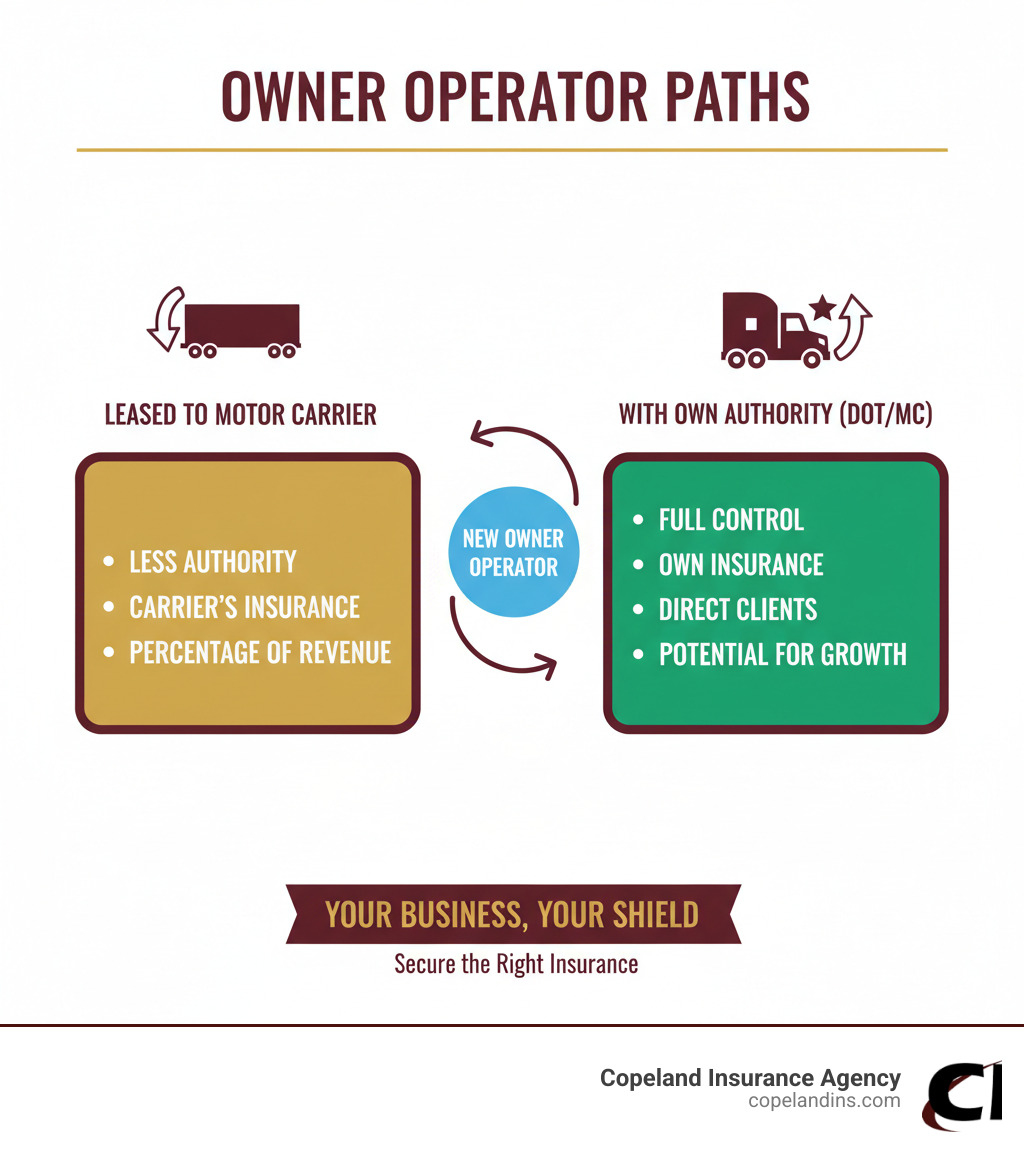
- Two Distinct Paths: Your specific insurance needs will be fundamentally different depending on your business model. Are you operating under your own authority, or are you leasing your services and truck to a larger motor carrier? The answer dictates the types of policies you are responsible for.
- Your Core Policy Package: For most new owner-operators, the initial package will include Primary Liability, Motor Truck Cargo, and Physical Damage insurance. If you are leasing on, you will need Non-Trucking Liability instead of Primary Liability.
The good news is that navigating this process does not have to be a source of stress. With the right expert guidance, securing the proper coverage can be a smooth and empowering step toward launching your business. Understanding what you need – and what you do not – can save you thousands of dollars annually while ensuring you are fully protected from the risks you will face on the road.
At Copeland Insurance Agency, we have dedicated over two decades to serving the trucking community. We are not generalists; we are specialists who live and breathe trucking insurance. Our team has successfully guided countless new owner-operators through the process of securing their first new owner operator insurance policies. Our mission is to demystify the complexities, make the process straightforward, and become your long-term partner, allowing you to focus on what you do best – building a profitable and successful trucking business.
Understanding Your Core Insurance Needs
Starting as a new owner operator is an exhilarating venture into entrepreneurship. Before you turn the key and hit the open road, it is absolutely critical to build a comprehensive understanding of commercial trucking insurance. This is not just a policy; it is the essential shield that keeps your business operating safely, legally, and profitably. Your specific insurance requirements will hinge on one key decision: whether you will operate under your own authority or lease on to an established motor carrier. At Copeland Insurance Agency, we specialize in helping truckers across Kansas, from Salina to Junction City, design tailor-made insurance solutions that perfectly fit their unique operational path.
For Owner-Operators with Their Own Authority
Choosing to operate with your own authority means you are the captain of your own ship. You are an independent business, and with that independence comes the full responsibility of securing all your own insurance coverages. This is a significant step that gives you ultimate control over your business, but it also means you are directly accountable to the FMCSA and your clients. The FMCSA will not grant your operating authority (your MC number) until you have filed proof of sufficient liability and cargo insurance. This filing, known as a BMC-91X for liability, is an electronic confirmation sent from your insurance company to the FMCSA. This is a critical administrative step that we can help you navigate smoothly and efficiently. You can review the official government guidelines on the FMCSA insurance requirements page.
Here are the foundational coverages you will be required to purchase:
-
Primary Liability Insurance: This is the absolute bedrock of your insurance portfolio. It provides coverage for bodily injury to other people and damage to their property if you are found at fault in an accident. For example, it would cover the medical bills of an injured driver in another vehicle, the repair costs for their car, and any damage to public property like a guardrail. While the FMCSA’s legal minimum for general freight is $750,000, the functional minimum in the industry is $1,000,000, as this is what most freight brokers and shippers require to do business. If you plan to haul hazardous materials, this requirement can jump to $5,000,000 or more. This coverage is non-negotiable for legal operation. Learn more about this crucial protection here: Truck Liability Insurance.
-
Motor Truck Cargo Insurance: This policy protects the freight you are hauling from financial loss if it is damaged or destroyed due to perils like a collision, fire, theft, or hitting a deer. Imagine hauling a load of electronics valued at $80,000 and your trailer is stolen from a truck stop. Without cargo insurance, you would be personally liable to the shipper for that entire amount. Most brokers require a minimum of $100,000 in coverage. However, the correct limit depends entirely on the value of the goods you haul. It is vital to ensure your limit is high enough for the most valuable load you might carry. Some policies also offer valuable endorsements like Reefer Breakdown coverage, which protects against spoilage if your refrigeration unit fails.
For Owner-Operators Leased to a Motor Carrier
If you choose to lease your truck and services to a motor carrier, their primary liability and cargo insurance policies typically extend to you, but only while you are operating under their dispatch and hauling a load for them. This arrangement simplifies some aspects, but it creates significant coverage gaps that you are personally responsible for filling. Assuming the carrier’s insurance covers everything is a costly mistake.
Here are the key coverages you will need to secure for yourself:
-
Non-Trucking Liability (NTL) Insurance: This is essential. It provides liability coverage for property damage or bodily injury to a third party when you are using your truck for non-business purposes. This includes driving to the grocery store, heading home after dropping a load, or taking your truck to a repair shop. Since you are not under dispatch for the carrier, their policy will not respond to a claim. NTL, often confused with bobtail insurance, protects you during these personal use periods. Dive deeper into NTL here: What is Non-Trucking Liability Insurance? Everything You Need to Know.
-
Physical Damage Insurance: This is a must-have for any truck owner, regardless of their operating structure. It covers the cost to repair or replace your own truck and trailer if they are damaged in an accident or by other perils. It is typically composed of two parts: Collision (covers rollovers and collisions with other objects) and Comprehensive (covers non-collision events like fire, theft, vandalism, hail, or striking an animal). Your motor carrier’s policy does not cover your equipment, and if you have a loan on your truck, your lender will absolutely require you to carry this coverage to protect their investment.
-
Trailer Interchange Insurance: This is crucial if you pull trailers owned by others under a written trailer interchange agreement. This is common in intermodal and drayage operations. It covers physical damage to the non-owned trailer while it is in your care, custody, and control. Without it, you would be on the hook for thousands of dollars in repair costs if you damaged a trailer you were borrowing.
Key Coverage Types Explained
Understanding the nuances of these vital coverages is the first step in building a robust new owner operator insurance plan that leaves no gaps.
| Coverage Type | Coverage Scope | When It Applies | Typical Limits (Liability/Cargo) |
|---|---|---|---|
| Primary Liability | Covers bodily injury and property damage to other parties if you are at fault in an accident. This is third-party coverage. | Required for all commercial operations under your own authority. Applies when you are under dispatch. | $750,000 – $1,000,000+ |
| Non-Trucking Liability | Covers bodily injury and property damage to other parties when your truck is being used for personal, non-business purposes and not under dispatch. | Applies when you are leased to a carrier and using your truck for personal errands, driving home, or bobtailing without dispatch orders. | $1,000,000 |
| Motor Truck Cargo | Covers loss or damage to the freight you are hauling due to specified perils like theft, fire, collision, or mishandling. | Applies when you are transporting goods for hire. Essential for owner-operators with authority and often required by carriers for leased operators. | $100,000 – $250,000+ |
Beyond these fundamentals, let’s explore a few more that protect your valuable assets:
-
Physical Damage Insurance: As mentioned, this protects your truck and trailer. It is important to understand the valuation method: Actual Cash Value (ACV) pays the depreciated market value of your truck at the time of the loss, while Stated Amount coverage lets you insure the truck for a specific value, which is the maximum the policy will pay. Discussing which is right for you with your agent is critical.
-
General Liability Insurance: While primary liability covers accidents involving your truck, general liability covers other business risks that can occur off the road. Examples include a client slipping and falling at your home office, you accidentally causing property damage while making a delivery on foot, or facing a lawsuit for libel or slander. It covers your business operations beyond the truck itself.
For a deeper dive into protecting your loads, you can find more detailed information here: Cargo Insurance for Trucks.
Beyond the Basics: Additional Business Protection
As a new owner operator and small business owner, you should consider these additional policies to create a vital safety net for your personal and financial well-being.
-
Workers’ Compensation / Occupational Accident Insurance: If you hire any employees in Kansas, workers’ compensation is legally required. It covers medical expenses and lost wages for employees injured on the job. As a solo owner-operator, you are not an employee, so a more affordable and popular alternative is Occupational Accident (Occ/Acc) insurance. This policy provides you, the driver, with medical, disability, and death benefits for on-the-job injuries, filling a similar role to workers’ comp but for independent contractors. Learn more about the benefits: Why Should Truckers Invest in Occupational Accident Insurance?.
-
Cyber Liability Insurance: In today’s digital world, even small trucking businesses handle sensitive information, including broker agreements, customer data, and financial records. This insurance helps cover the significant costs resulting from a data breach or cyber-attack, such as data recovery, legal fees, customer notification, and reputational damage control.
-
Business Interruption Insurance: Also known as downtime coverage, this can be a business-saver. This coverage replaces lost income and helps cover ongoing fixed expenses (like your truck payment and insurance premium) if a covered event, such as a major accident and lengthy repair, forces you to stop operating temporarily. It provides the cash flow needed to survive a period with no revenue.
-
Personal Property Coverage: Your standard commercial auto policy does not cover your personal belongings inside the cab. This endorsement protects your personal items like your laptop, GPS unit, tools, and clothes from theft or damage during a covered event.
-
Breakdown Coverage: Often offered as a roadside assistance program, this valuable add-on covers the costs of towing and labor for unexpected mechanical breakdowns. It can significantly reduce your out-of-pocket expenses and help you get back on the road faster, minimizing costly downtime.
Navigating the World of New Owner Operator Insurance
Now that we have detailed the essential coverages, let’s shift gears to the practical side of things: understanding what drives your insurance costs and how to strategically find the right insurance partner for your new owner operator journey. As a new venture, your premiums will likely be higher, but knowing these factors empowers you to take control and positively influence your rates over time.
Key Factors Influencing New Owner Operator Insurance Costs

Numerous variables combine to determine your final new owner operator insurance premium. Insurance is a business of risk assessment, and underwriters will scrutinize every detail of your new operation. Understanding these factors helps you present yourself as a lower-risk client and make smart business decisions that can lead to significant savings.
-
Driving History & CDL Experience: This is arguably the most significant factor. Insurers will pull your Motor Vehicle Report (MVR) to review your driving record for the past 3-5 years. A clean record free of accidents, speeding tickets, and serious violations (like DUIs or reckless driving) is paramount for obtaining affordable rates. The length of time you have held your CDL is also critical. Many standard insurance carriers have a strict requirement of at least two years of verifiable CDL experience. Drivers with less experience are considered higher risk and will face higher premiums and have fewer carrier options.
-
Truck Details (Year, Make, Model, and Value): The age, type, and particularly the value of your truck directly impact your physical damage premiums. A brand-new, $180,000 tractor will cost significantly more to insure than a 10-year-old, $40,000 unit because the potential claim payout is much higher. However, some newer trucks equipped with advanced safety features like collision mitigation systems and lane departure warnings may qualify for discounts that can help offset the higher value.
-
Operating Territory (Radius of Operation): Where you drive matters immensely. Your planned routes have a direct correlation to risk. Operating primarily in rural or regional areas like central Kansas may result in lower rates than long-haul routes that take you through densely populated urban centers like Chicago or Los Angeles. Certain states are known as high-risk venues due to factors like extreme weather, high traffic volume, or a litigious legal environment (e.g., Florida, New York, Louisiana), and operating in them will increase your premium.
-
Cargo Type: What you haul is a major rating factor for your cargo and liability insurance. Hauling general, non-perishable dry goods is the baseline for risk. Premiums increase as the risk associated with the cargo grows. Hauling hazardous materials (hazmat) carries the highest risk and requires significantly higher liability limits and specialized endorsements. Other high-risk categories include refrigerated goods (risk of spoilage), high-value electronics (theft risk), and automobiles (risk of damage).
-
Coverage Limits & Deductibles: This is a straightforward calculation. Higher liability and cargo limits mean more potential exposure for the insurance company, which translates to a higher premium. Conversely, your deductible-the amount you pay out-of-pocket on a claim before insurance kicks in-has an inverse relationship with your premium. Choosing a higher deductible (e.g., $2,500 instead of $1,000) will lower your monthly or annual premium, but it requires you to have more cash on hand in the event of a claim.
-
Credit Score & Claims History: In many states, including Kansas, insurers are permitted to use a credit-based insurance score to help determine premiums. Statistically, there is a correlation between responsible financial management and safer driving behavior. A strong credit history can lead to lower rates. Additionally, any past insurance claims, even those that occurred while you were a company driver, can be considered and may affect your premium.
For a deeper dive into how these elements shape your costs, check out our detailed guide: How Much is Truck Insurance?.
How to Find the Right Provider and Compare Quotes
Finding the right insurance provider is not just about finding the lowest price; it is about finding a long-term partner who understands the trucking industry and can provide the robust protection and responsive service your business needs to thrive.
We strongly recommend working with an independent insurance agent who specializes in commercial trucking. Unlike a captive agent who only represents one company (like Progressive or Allstate), or a faceless online portal, a specialized independent agent understands the nuances of FMCSA filings, UIIA requirements, and trucking-specific risks. As independent agents, we at Copeland Insurance Agency have access to a wide range of A-rated insurance carriers that focus on trucking. This allows us to shop the market on your behalf to find the best combination of coverage, service, and price, rather than trying to fit you into a single company’s box. Learn more about why that matters here: Why Should I Talk to an Insurance Agent and Not Just Buy My Insurance Online?.
Before you start seeking quotes, gather all your necessary information. This includes your CDL, your DOT and MC numbers (if you have them), the VIN, year, make, and model of your truck and trailer, and a clear business plan detailing your intended radius of operation and cargo types. The more detailed and accurate the information you provide, the more accurate your quotes will be.
When comparing quotes effectively, you must look beyond the bottom-line premium. A cheap policy is often cheap for a reason-it may have dangerous coverage gaps or high deductibles. Scrutinize the coverage limits, deductibles, and any listed exclusions. Check the AM Best rating of the insurance carrier, which indicates their financial stability and ability to pay claims. Finally, ask about the provider’s claims process and read reviews about their customer service. A great price is meaningless if you cannot get ahold of anyone when you have a claim.
Pro Tips for Securing Affordable and Adequate Coverage
Getting your insurance strategy right from the very beginning is a cornerstone of long-term success in the trucking industry. Your new owner operator insurance is more than just an expense; it is the financial backbone that gives you the confidence to haul loads, knowing that you are protected from the inherent risks of the road. A smart, proactive approach can save you money and position your business for sustainable growth.
Smart Strategies for Your New Owner Operator Insurance Policy

Preparation and strategic planning are key to securing the best possible policy without overpaying. Drawing on our experience helping hundreds of truckers in Kansas and across the country, here are some of the most effective strategies for new owner-operators.
-
Start Early and Be Patient: Begin the insurance shopping process 30-45 days before you plan to start hauling. This is not a process you can rush. Once you get your MC number, there is often a mandatory 21-day vetting period before your authority becomes active. Your insurance filings must be completed during this time. Starting early gives you ample time to compare quotes without pressure, allows your agent to find the best options, and ensures all administrative timelines are met without causing delays to your business launch.
-
Bundle Policies for Savings and Simplicity: Whenever possible, purchase your core policies-such as primary liability, physical damage, and motor truck cargo-from a single insurance provider. Most carriers offer a multi-policy discount, which can lead to significant savings. Beyond the cost benefit, bundling also simplifies your life. You will have one point of contact, one bill to pay, and a streamlined claims process if an accident involves multiple aspects of your coverage.
-
Aggressively Seek Out Discounts: Do not assume discounts will be automatically applied. Always ask your agent what discounts you might be eligible for. Common discounts include those for paying your premium in full for the year, having a clean driving record for the past three years, installing safety technology like dashcams and ELDs, having prior business ownership experience, or completing certified safety training courses. Some carriers even offer discounts for military veterans.
-
Choose Your Deductible Wisely: Your deductible is the amount of risk you are willing to assume personally. A higher deductible will lower your premium, but you must be financially prepared to pay that amount out-of-pocket if you have a claim. For example, raising your physical damage deductible from $1,000 to $2,500 could save you hundreds on your premium, but you need to have that $2,500 readily available. Choose a deductible that strikes a balance between premium savings and your comfortable cash-on-hand level.
-
Commit to an Annual Policy Review: Your trucking business is not static, and your insurance policy should not be either. Schedule a review with your agent every year before your renewal. Did you buy a new truck? Have your hauling routes changed? Are you carrying different types of cargo? Any of these changes can impact your coverage needs and rates. An annual review ensures your policy evolves with your business and allows your agent to see if your improved experience or safety record now qualifies you for better rates.
-
Read Your Policy and Understand Exclusions: It is crucial to know what your policy does and does not cover before you have a claim. Pay special attention to the exclusions section. For example, many cargo policies exclude coverage for theft if the truck was left unattended in a high-theft area, or for certain types of goods like tobacco or fine art. At Copeland Insurance Agency, we believe in proactive education. We would much rather spend an hour explaining your coverage to you now than have you discover a gap after an accident.
Leveraging Insurance for Business Growth
Viewing your new owner operator insurance as a strategic tool, rather than just a necessary evil, can unlock opportunities and protect your ability to grow.
-
Meet and Exceed Load Board Requirements: The vast majority of load boards and freight brokers require proof of at least $1,000,000 in auto liability and $100,000 in cargo insurance. Having this coverage in place is the basic ticket to entry, making you eligible for a wide array of freight. Consider carrying higher limits, such as $2,000,000 in liability, which can make you eligible for more exclusive and higher-paying loads from larger corporations or government contractors.
-
Provide Instant Certificates of Insurance (COIs): Before a broker or shipper will give you a load, they need a COI to verify your coverage. In the fast-paced world of trucking, speed is everything. A responsive insurance provider like Copeland Insurance Agency that can issue these certificates quickly and accurately-even after hours-is a competitive advantage. A slow agent can literally cost you a load and damage your reputation.
-
Ensure Business Continuity: A solid insurance plan provides the financial buffer needed to recover from a major accident, cargo loss, or catastrophic breakdown. It prevents a single incident from derailing your entire business. This is especially critical for new ventures that may not have deep cash reserves. This concept is a core part of our guidance for new businesses, as discussed in our guide on Trucking Insurance for Startups.
-
Protect Your Most Valuable Assets: Your business is built on your assets. Physical damage coverage protects your truck and trailer-your largest and most important investment. Liability and cargo insurance shield your business entity and personal finances from potentially devastating lawsuits and claims that could otherwise wipe you out.
-
Build a Strong Safety Record for Long-Term Savings: The ultimate way to lower your insurance costs is to operate safely. A history of safe operation, documented by a clean MVR and a good CSA score, is the most powerful leverage you have at renewal time. Safe driving and well-maintained equipment are not just best practices; they are direct investments in reducing your long-term insurance costs.
Frequently Asked Questions about Owner-Operator Insurance
We know that diving into the world of new owner operator insurance can bring up a lot of questions and uncertainty. At Copeland Insurance Agency, we believe in empowering our clients with knowledge. Here are clear, straightforward answers to some of the most common questions we hear from aspiring owner-operators.
What is the minimum insurance required by the FMCSA for an owner-operator with their own authority?
The absolute legal minimum set by the Federal Motor Carrier Safety Administration (FMCSA) is $750,000 in primary auto liability coverage for trucks over 10,000 lbs hauling non-hazardous freight. However, it is critical to understand that this is not the industry standard. To gain access to loads from reputable brokers and shippers, you will almost universally be required to carry $1,000,000 in primary liability. You will also need to carry Motor Truck Cargo insurance, with the industry standard being a $100,000 limit. If you plan to haul hazardous materials, the liability requirement increases to $1,000,000 or $5,000,000, depending on the specific materials.
Do I need my own insurance if I am leased to a motor carrier?
Yes, absolutely. This is a common and dangerous misconception. While the motor carrier’s primary liability and cargo policies cover you when you are under their dispatch, that coverage stops the moment you are not working for them. You are responsible for securing your own policies to fill these critical gaps. This includes Non-Trucking Liability insurance to cover you during any personal use of the truck, and Physical Damage insurance to protect your truck and trailer from collision, fire, theft, or other perils. The carrier’s policy does not cover your personal equipment. Additionally, if you pull trailers you do not own under an interchange agreement, you will also need Trailer Interchange insurance.
How can I lower my insurance costs as a new owner-operator?
New ventures inherently face higher premiums due to a lack of business history, but you have more control than you think. The most impactful strategy is to maintain a spotless driving record. Over time, as you build a history of safe operation and gain more CDL experience, your rates will naturally decrease. In the short term, you can lower costs by installing safety technology like dashcams, paying your premium in full annually (which often comes with a 5-10% discount), and choosing a higher deductible that you can comfortably afford. The most important step is to work with a specialized independent agent at Copeland Insurance Agency. We can shop your policy across multiple carriers to find the best rates and ensure you receive every applicable discount.
What is the difference between Bobtail and Non-Trucking Liability (NTL) insurance?
These terms are often used interchangeably, but they are technically different. Bobtail insurance covers you when you are driving your tractor without a trailer attached, regardless of whether you are under dispatch or not. Non-Trucking Liability (NTL) is broader; it covers you anytime you are using the truck for non-business, personal purposes, whether a trailer is attached or not. Today, NTL is the much more common and relevant coverage for owner-operators leased to a motor carrier, as it provides the clear distinction of personal use versus business use that carriers require.
How much does new owner operator insurance actually cost?
This is the million-dollar question, and the answer is: it varies widely. For a new owner-operator with their own authority, a clean record, and good credit, the total annual premium for a standard package (liability, cargo, physical damage) can range from $12,000 to $20,000 or more. Factors like your driving record, CDL experience, location, hauling radius, and cargo type will all have a massive impact. A driver with less than two years of experience or a prior accident could see rates significantly higher than this. The only way to know for sure is to get a detailed quote from a qualified agent.
Can I get insured with a brand new CDL or less than two years of experience?
Yes, but it will be more challenging and more expensive. Many standard insurance carriers will not write policies for drivers with less than two years of verifiable CDL experience. New drivers are seen as a much higher risk. However, there are specialty carriers and programs designed for new drivers, and an experienced agent can help you access them. Be prepared for higher premiums for your first couple of years until you have built a proven track record of safety.
Conclusion: Hit the Road with Confidence
As you prepare to launch your dream of becoming an owner-operator, remember that securing the right new owner operator insurance is not just another task on a long checklist. It is the act of laying the strongest possible foundation for your new business. This goes far beyond simply meeting legal requirements; it is about building a solid financial backbone that protects your truck, your income, and your entire future on the open road. With a comprehensive and well-designed insurance portfolio, you gain invaluable peace of mind, knowing that your hard work, your investment, and your livelihood are safeguarded against the unexpected.
This peace of mind is the direct result of a clear process: understanding your unique operational needs, carefully comparing your options, and-most importantly-partnering with an insurance expert who truly understands the trucking industry. That is precisely where Copeland Insurance Agency excels. We are passionate about providing high-quality insurance products and dedicated, caring service at prices that make sense for new and established owner-operators across Kansas, from Salina and Junction City to Manhattan and Topeka.
We understand the unique challenges and incredible rewards of being your own boss on the road. Our primary goal is to cut through the jargon and confusion of the insurance world, helping you steer through the complexities with ease. By handling this critical component for you, we free you up to keep your focus where it belongs: on the road, safely hauling freight, and growing your business one mile at a time.
Key Takeaways for Your Journey:
- Insurance is Your Shield: It is your primary defense against financial ruin from an accident.
- Know Your Path: Your needs differ greatly if you have your own authority versus leasing on.
- Start Early: Give yourself at least 30-45 days to get quotes and complete filings.
- Work with a Specialist: A dedicated trucking agent is your most valuable ally.
- Safety is Your Best Investment: A clean driving record is the number one way to lower your costs over time.
Do not let paperwork or uncertainty put the brakes on your entrepreneurial dreams. Let Copeland Insurance Agency be your trusted co-pilot in securing the comprehensive coverage you need to succeed. Reach out to us today to have a conversation about your new owner operator insurance needs and get a personalized, no-obligation quote. We are ready to help you hit the road with total confidence.