

Insurance for Box Trucks: Smart & Secure 2025
Why Box Truck Insurance Is Essential for Your Business Success
Insurance for box trucks protects your business from financial disasters when operating commercial vehicles. Whether delivering furniture, hauling equipment, or transporting goods, the right coverage keeps your business running if accidents, theft, or damage occur.
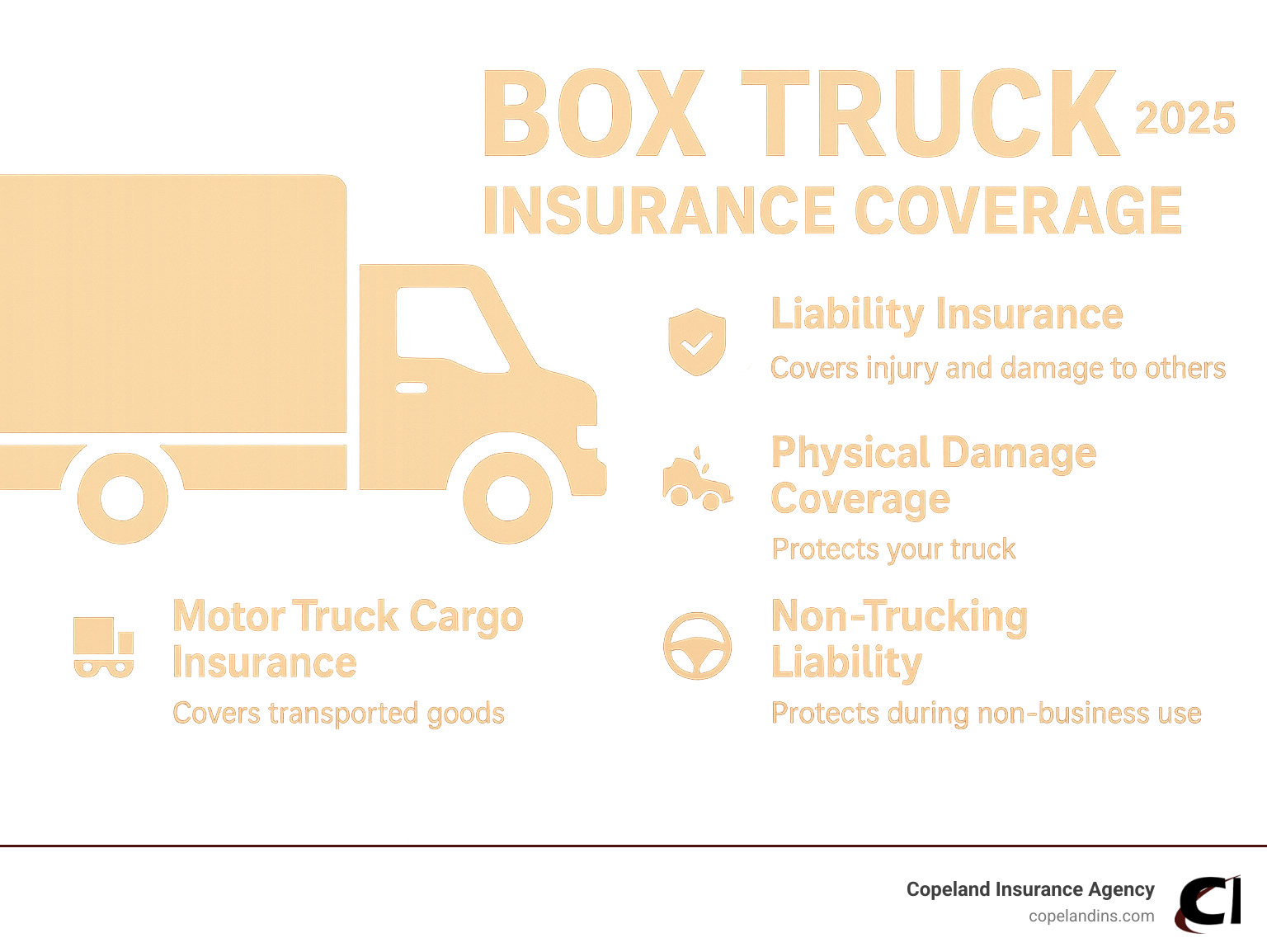
Essential box truck insurance coverages include:
- Liability Insurance – Covers bodily injury and property damage to others
- Physical Damage Coverage – Protects your truck from collision and comprehensive losses
- Motor Truck Cargo Insurance – Covers goods you’re transporting
- Non-Trucking Liability – Protects when using truck for personal purposes
Box trucks are the short-haul heroes of American commerce. As one industry expert noted, they “fill gaps in the transportation industry, carrying cargo from warehouses, depots, and distributors or hauling materials to worksites.” These versatile vehicles—also called straight trucks or cube vans—face unique risks that personal auto policies don’t cover.
The financial stakes are high. Driving without proper truck insurance can result in fines from $5,000 to $25,000 in places like Ontario, plus license suspension. Many operators pay $3,000 to $5,000 annually for liability coverage alone, an investment that protects against claims that can reach six or seven figures.
As Copeland Insurance Agency, we’ve spent over two decades helping business owners steer commercial vehicle coverage, including specialized insurance for box trucks. Understanding your options upfront saves money and headaches.
Insurance for box trucks basics:
- commercial truck and trailer insurance
- cheap commercial auto insurance
- commercial vehicle insurance company
The Fundamentals: What is Box Truck Insurance and Who Needs It?

Insurance for box trucks is a specialized commercial auto policy designed to protect businesses that rely on these vehicles. It acts as a financial safety net against accidents, theft, or damage that could threaten your operations. This coverage is a critical part of legal compliance and risk management for any business using box trucks. Without it, you put your entire business on the line.
What Businesses and Vehicles Are Covered?
If your business uses a box truck, you need insurance for box trucks. This applies to a wide range of businesses, including movers, couriers, retail distributors, furniture delivery services, landscapers, caterers, and construction companies. Essentially, if you depend on a box truck to get the job done, you need this coverage.
The term “box truck” covers a large family of vehicles, including straight trucks, tilt cabs, refrigerated box trucks (“reefers”), cargo cutaways, sleeper box trucks, moving trucks, cube vans, and rack trucks. Any commercial vehicle with an enclosed cargo area needs specialized box truck insurance, which is different from personal auto insurance. For more details on covering your business vehicles, see our insights on Business Auto Insurance.
Why is Specialized Insurance Necessary?
A common question is whether a personal auto policy is sufficient. The answer is no. Personal policies are not designed for commercial risks, have lower liability limits, and include exclusions for business use. A claim filed during work use will likely be denied, leaving you financially exposed.
Box trucks carry higher liability risks due to their size, weight, and valuable cargo. Accidents can result in claims far exceeding those of passenger cars, potentially reaching millions of dollars.
Specialized insurance for box trucks is essential to:
- Protect your business assets: Your truck is a vital investment. A serious accident without proper coverage could halt your operations.
- Meet contractual requirements: Many clients require proof of adequate commercial insurance, including specific liability and cargo limits, before hiring you.
- Ensure legal compliance: States mandate commercial auto insurance. Non-compliance leads to severe penalties, including hefty fines, license suspension, and vehicle impoundment. For sole proprietors, personal health insurance may not cover work-related injuries, making commercial coverage even more critical.
This specialized insurance is an indispensable shield against the substantial risks of commercial trucking.
Building Your Policy: Essential Insurance Coverages for Box Trucks

Building your insurance for box trucks policy means combining foundational coverages with specialized options that fit your unique operation. At Copeland Insurance Agency, we help you customize your policy to protect what matters most without paying for what you don’t need. Through endorsements and riders, we build comprehensive protection custom to your specific risks, because no two trucking businesses are alike.
Foundational Coverages for Every Box Truck
Every solid insurance for box trucks policy starts with these essential coverages.
Liability Insurance is your first line of defense. If your box truck causes an accident, it protects your business assets from potentially devastating lawsuits. It is typically split into two parts: Bodily Injury Liability, which covers others’ medical bills, rehabilitation costs, lost wages, and even pain and suffering, and Property Damage Liability, which pays for repairs to other vehicles, buildings, fences, or any other property damaged in the incident. State-required minimums are often dangerously low for commercial vehicles. A single serious accident can easily generate claims in the six or seven figures, making higher limits a crucial investment to fully protect your business from financial ruin.
Physical Damage Coverage protects your truck itself, which is often one of your most valuable business assets. This coverage is also typically required if you have a loan or lease on your vehicle. It includes Collision Coverage, which pays for repairs when your truck hits another vehicle or object, such as a guardrail or telephone pole, or if it overturns. Comprehensive Coverage handles non-collision events, offering a broad safety net against perils like theft, vandalism, fire, hail, flooding, falling objects, and even hitting an animal. Without this coverage, you would be responsible for the full cost of repairing or replacing your truck out-of-pocket.
Uninsured and Underinsured Motorist Coverage protects you from other drivers who don’t carry enough—or any—insurance. Unfortunately, many drivers on the road carry only the state minimum coverage, which is often insufficient to cover the extensive damage they might cause to your commercial vehicle and cargo. This coverage steps in to pay for your repairs and medical costs when the at-fault driver’s policy falls short.
Medical Payments Coverage (MedPay) covers medical expenses for you and your passengers after an accident, regardless of who caused it. This coverage kicks in quickly to help pay for immediate medical bills, such as ambulance rides, hospital visits, and X-rays, without waiting for a fault determination. For broader business protection beyond your vehicles, consider our General Liability Insurance.
Specialized Coverages for Trucking Operations
Once the foundation is in place, you can add specialized coverages that address the unique risks of box truck operations.
Motor Truck Cargo Insurance is critical if you haul goods for others or transport your own valuable products. A standard policy covers your truck, not the cargo inside. Cargo insurance protects the goods you’re transporting from perils like theft, fire, and damage from a collision. Coverage limits can range from $10,000 to over $250,000, and select a limit that reflects the maximum value of the goods you carry at any one time. For refrigerated trucks, you can add Refrigeration Breakdown protection, which covers spoilage losses if your cooling unit fails. Be aware of potential exclusions, such as for certain high-value items or damage from improper packing. Learn more on our Cargo Insurance page.
Loading and Unloading Coverage extends protection to the high-risk period when goods are being moved on and off your truck. Many accidents and cargo damage incidents happen during this process, and this endorsement ensures you’re covered.
Debris Removal Coverage helps pay to clean up spilled cargo and other wreckage after an accident. These costs can be surprisingly expensive and are often not included in standard liability or cargo policies.
Trailer Interchange Insurance is important if you use trailers you don’t own under a written trailer interchange agreement. This provides physical damage protection for the non-owned trailer while it’s in your care, custody, and control.
Non-Trucking Liability (or Bobtail Insurance) fills a crucial gap for owner-operators leased to a motor carrier. When you drive your truck for personal use (e.g., driving home after a drop-off), your primary trucking liability isn’t active. This coverage provides liability protection during those non-business, personal uses.
If you have employees, Workers’ Compensation Insurance is typically required by state law. It covers medical expenses and lost wages for employees injured on the job and protects your business from related lawsuits. Penalties for non-compliance are severe. Get details on our Workers Compensation Insurance page.
By combining these coverages, we help you build an insurance for box trucks policy that truly protects your business.
Decoding the Price Tag: Cost Factors and Savings Strategies

“What will this cost?” is a key question for any business owner shopping for insurance for box trucks. The answer depends on your unique situation. Most operators pay between $3,000 to $5,000 annually for liability coverage alone (roughly $250 to $417 monthly for a $1 million policy). However, your actual cost will vary based on several factors.
Key Factors That Determine the Cost of Insurance for Box Trucks
Insurance companies look at your business’s specific risk profile to determine your premium.
Your vehicle’s specs matter. The make, model, year, and value of your box truck directly impact your premium. A larger truck costs more to insure because it can cause more damage and is more expensive to replace.
Driving records are crucial. Clean driving records for all drivers can significantly lower your rates, while a history of accidents or violations will increase them. Past mistakes can affect your rates for several years.
Your business’s claims history speaks volumes. A history of frequent or expensive claims will increase your rates, while a clean record will help lower them.
Geography and operating radius play a big role. A truck that stays in rural areas faces different risks than one navigating busy city streets or crossing state lines, which influences your premium.
What you’re hauling affects your rates. Transporting hazardous materials or high-value goods carries more risk than hauling basic items, and your rates will reflect that.
Your coverage choices directly impact cost. Higher liability limits and lower deductibles will increase your premium. It’s about balancing protection with affordability. For a detailed breakdown, check our guide on How Much Does Box Truck Insurance Cost?.
How to Save Money on Your Premiums
There are proven ways to lower your insurance for box trucks costs without sacrificing protection.
Bundle policies for savings. Combining your box truck insurance with other business coverages like property or general liability usually earns an attractive discount. Our customers often save around 12% on auto insurance when bundling.
Choose deductibles strategically. A higher deductible can lower your premium, but make sure you can comfortably afford the out-of-pocket expense if you file a claim.
Maintain clean driving records. This factor has one of the biggest impacts on your rates. Encouraging safe driving habits among all your drivers will lead to significant savings over time.
Implement safety programs. Regular vehicle maintenance and driver training show insurers you’re serious about preventing accidents, which can lead to lower premiums.
Pay annually. Paying your premium upfront instead of in monthly installments often earns a discount and avoids processing fees.
Work with an independent agent. This is where Copeland Insurance Agency shines. Unlike captive agents, we partner with multiple carriers. We shop around on your behalf to compare quotes and find the best combination of coverage and price for your needs. Our loyalty is to you.
Navigating Legal Roads: Requirements for Private vs. For-Hire Truckers
Navigating commercial regulations for box trucks can be complex. Between state and federal rules, it’s easy to get confused. For insurance for box trucks, a key question is whether you’re hauling your own goods or moving them for others. This distinction significantly changes your coverage needs.
Understanding State and Federal Requirements
Every state has its own rules for commercial vehicles, including minimum liability insurance amounts, which can vary by your truck’s weight (GVW). It’s crucial to know the specific laws for every state you operate in, from Kansas to Arizona and beyond.
If your box truck crosses state lines or carries certain cargo, federal rules from the Federal Motor Carrier Safety Administration (FMCSA) also apply. The Federal Motor Carrier Safety Administration (FMCSA) requires specific coverages, and you may need a DOT and/or MC number for interstate hauling.
Ignoring these rules can lead to large fines and penalties. Copeland Insurance Agency can help ensure your insurance for box trucks meets all state and federal guidelines. For a full rundown, see our insights on Commercial Transportation Insurance.
How Insurance Needs Differ for Private Carriers vs. For-Hire Truckers
The difference between carrying your own goods versus someone else’s for a fee is a game-changer for your insurance for box trucks policy.
| Feature | Private Carrier (Hauling Your Own Goods) | For-Hire Trucker (Transporting Goods for Others) |
|---|---|---|
| Primary Purpose | Transporting your own company’s goods or equipment (e.g., landscaper, furniture store). | Transporting goods for other businesses or individuals for a fee (e.g., courier, moving company). |
| Typical Coverage Needs | – Primary Liability: Covers accidents you cause. – Physical Damage: Protects your truck. – Cargo Coverage: If your own goods are valuable. |
– Primary Liability: Often covered by the motor carrier you’re leased to, but you may need to ensure it. – Motor Truck Cargo Insurance: Essential for goods you’re paid to transport. – Non-Trucking Liability (Bobtail): For off-duty driving. |
| Key Distinction | Your business owns the goods being transported. | Your business is paid to move someone else’s goods. |
Private Carriers use their box trucks to move their own company’s goods (e.g., a landscaper’s tools or a store’s inventory). Your insurance for box trucks should focus on strong Primary Liability and Physical Damage coverage. If your own goods are valuable, you should also consider Cargo Coverage.
For-Hire Truckers move other people’s property for a fee, such as freight companies or movers. Your insurance needs are more complex because you are responsible for others’ valuables. Essential coverages include:
- Primary Liability: Understand what is covered by any motor carrier you are leased to and when.
- Motor Truck Cargo Insurance: This is a must-have to protect the goods you’re paid to transport from loss or damage.
- Non-Trucking Liability (Bobtail) Insurance: This is critical for protecting you when your truck is used for non-business purposes, as the motor carrier’s primary liability won’t apply.
For businesses focused on specific for-hire jobs, check our page on Parcel Delivery Contractor Insurance to fine-tune your needs.
Frequently Asked Questions about Insurance for Box Trucks
Navigating insurance for box trucks is complex, and it’s normal to have questions. We’re here to answer some of the most common queries we receive.
Does insurance for a 26-foot box truck cost more than for a smaller one?
Yes. The size and type of your box truck significantly impact the cost of your insurance for box trucks. A larger 26-foot box truck will be more expensive to insure than a smaller one. Larger vehicles with a higher Gross Vehicle Weight (GVW) carry more risk, as they can cause more extensive damage in an accident. This higher risk leads to higher potential liability claims and, therefore, higher premiums.
Are the contents of my truck covered by a standard policy?
Generally, no. A standard commercial auto policy covers your vehicle and liability, but it does not cover the cargo you’re hauling. If the goods you’re transporting are damaged in a collision or stolen, a standard policy won’t cover the loss. To protect the contents, you need a separate coverage called Motor Truck Cargo insurance. This is essential for businesses like movers or delivery services. Learn more on our Cargo Insurance page.
What happens if I use my personal vehicle for business?
Using a personal vehicle for business purposes can leave you dangerously exposed. Your personal auto policy is designed for personal use and will likely deny a claim if an accident occurs while you’re working. This would leave you personally responsible for all damages and legal fees. To be properly covered, you need a commercial auto policy for any vehicle used for work. If that vehicle is a box truck, you need a dedicated Commercial Box Truck Insurance policy. While more expensive than personal insurance, it’s a necessary investment to protect your business from these higher risks.
Get the Right Coverage for Your Business
Securing the right protection for your box truck operations is vital for your business’s success. The first step is understanding your needs, from basic liability insurance and physical damage coverage to specialized options like cargo insurance and non-trucking liability.
At Copeland Insurance Agency, we provide quality insurance products with caring service at affordable prices. For over two decades, we’ve helped businesses like yours. With licenses in states like Arizona and Texas and deep roots in Kansas communities like Manhattan, Abilene, and Topeka, we understand the challenges you face on the road.
We are here to help you steer your insurance options and find a policy that fits your operations and budget, ensuring you’re protected for the long haul.
Don’t let insufficient insurance for box trucks leave your business vulnerable. Let us help you find the peace of mind that comes from knowing your business, drivers, and cargo are fully protected. Ready to roll? Get a quote for your commercial truck insurance today and let’s get you covered!